Home » News »
Melbourne airport upgrade plan – is it enough for air freight?
« Previous | Next »
You might have heard about the Melbourne airport upgrade. Did you ever consider how it will accommodate the growing volume of air freight? It appears like it might not be enough.
Importance of infrastructure for air freight growth
The April 2014 study of the Air Transport Action Group (ATAG) states that 35% of world trade by value is moved using air freight. Air freight is expected to hold this proportion of the freight market as it is the method that can move goods in the shortest time over long distances. It is ideal for goods that are required on short notice or that are perishable. With the continued growth in world trade, the volume of air freight will also increase as its proportion of the freight market stays relatively constant.
See the 24-hour time-lapse of world air traffic:
If Melbourne is to keep up with the growth in air freight, the upgrading of infrastructure for the air freight system in and around Melbourne’s main airport (Tullamarine) is vital. The infrastructure development needs to address increases in volumes and produce reductions in time. Efficient infrastructure for Melbourne Airport needs to consider factors such as:
- Improving airside layout and operation for increased air traffic flow
- Building additional terminals for increased aircraft handling volume
- Increasing warehouse space within and near the airport for increased handling capacity when transmitting goods to and from air freight and road transport systems
- Expanding the road structure to allow for larger volumes and faster movement of road transport into, out of and around the airport
Thorough planning is essential
Skyway Aviation Handling Company (SAHCOL) Managing Director Rizwan Kadri once said in an article:
“The cargo sub-sector is one of the most prominent, viable and promising of all the sectors in the aviation industry; most of the airlines earn a lot of revenue from this sector.
“Yes, it is a good idea, but then, merely announcing cargo airports without adequate facilities will not work. So, whatever they are doing has to be planned.
“Building cargo airports where you have the farmers but without infrastructure, such as good road network around them, cold room, as well as other storage facilities, will be tantamount to mere jamboree.”
It is reassuring that the Melbourne airport upgrade has been extensively planned.
Let us review the Melbourne upgrade plan in 2016
About Melbourne Airport
Melbourne airport has been with us for more than four decades. Take a glimpse on its early construction way back in 1967.
Today, Melbourne Airport is Australia’s main aviation hub for the southern part of the continent. Also, it is the second busiest passenger airport in Australia with almost 218,000 annual aircraft movement for the year 2013.
The following overview shows the various upgrades and new facilities either in progress or completed. It focuses more on the passenger aspect of the airport. However, it does show there have been several major improvements to road structures. This will improve road transport flow into, out of and around the airport.
The planning process
The development process of a master plan is governed by the Airports Act 1996 (Airports Act). It required Melbourne Airport to
- outline its strategic vision for the site over the next 20 year
- presents concept plans for the
- short term (five years)
- medium term (five to 20 years)
- long term (20-plus years)
The plan covers the subjects set out in Section 71 of the Airports Act and includes development objectives, future use forecasts, and environmental impacts. It is to cover the following aspects of the airport:
- Land use and development
- Airside development
- Runways
- Taxiways and aprons
- Air navigation facilities
- Terminal development
- Non-aviation development
- Utility development
- Water and sewerage
- Stormwater drainage
- Electricity
- Safeguarding strategies
- Airport roads
The first five years of the plan provides specific details about the proposed ground transport and commercial developments. It is also the first time the Melbourne airport has included a five-year environment strategy within its master plan.
Within the master plan are the Major Development Plans (MDPs). These must be consistent with the master plan. Further, they each have to be approved by the Commonwealth government as they:
- Costs more than $20M AUD each
- Each has an impact on the environment or local community
The planning process for the Melbourne airport upgrade was long and extensive. It was completed in 2013 and is meant to cover development for the next 20 years. The government is to invest $10B AUD over this period to continually improve the airport.
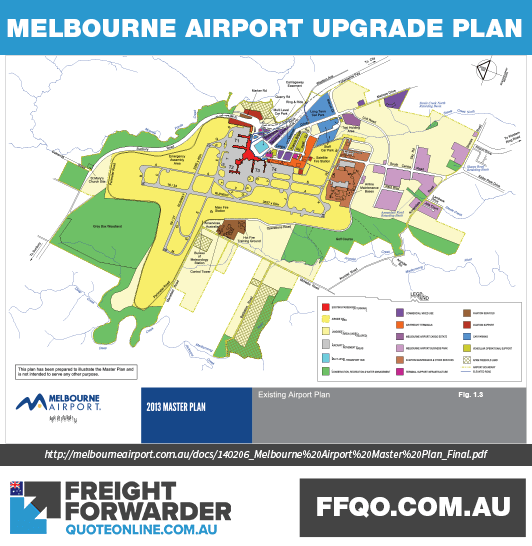
The ultimate Melbourne Airport development concept plan
How does the Melbourne Airport upgrade allow air freight growth
A careful analysis of the Melbourne Airport upgrade plan shows the following factors and been addressed in terms of infrastructure development for air freight:
Improved airside layout and operation
To allow for increases in air traffic flow the following aspects of airside have been allowed for:
- Expanding Taxiways – “Victor”
- Taxiway Slab Replacement Project – replacement of 40-year-old taxiways
- Southern Apron Expansion
Build additional terminals
A new terminal (T4) has been built for the domestic airlines Jetstar, Tigerair, and Rex to increase aircraft handling volume. This will allow more international flights to be handled at the other terminals.
Increase warehouse space
TNT and TOLL IPEC are to build new warehouses to increase handling capacity when transmitting goods to and from air freight and road transport systems. The TOLL IPEC warehouse is very large covering an area of 71,000 square meters.
Expanding the road structure
Larger volumes and faster movement of road transport into, out of and around the airport is being provided for by:
- Airport Drive Expansion – 3.6km, four-lane road
- Transport Hub and Elevated Loop Road
- Melrose Drive Expansion
For more information on the ongoing projects in Melbourne Airport, refer here.
The problem – air freight forecast for Melbourne Airport
The various improvements to infrastructure outlined in the Melbourne Airport Upgrade plan were developed from forecasts made in 2013. Chapter 4 of the Master Plan 2013 states:
“The global air cargo traffic growth will increase to average 5.2% over the next 20 years. It has also estimated that dedicated freight aircraft movement (both domestic and international) will rise from 7,200 [revenue tonnes-kilometres] per annum in 2011 to 12,300 by the year 2033.
“Assuming the inward and outward freight movement per aircraft remains at present levels, modelling suggests that Melbourne Airport will facilitate the movement of approximately 393,000 tonnes of international freight by 2033.”
Based on the 2013 Master Plan, here’s what we can expect after the 20-year plan improvement of Melbourne Airport in relation to air freight.
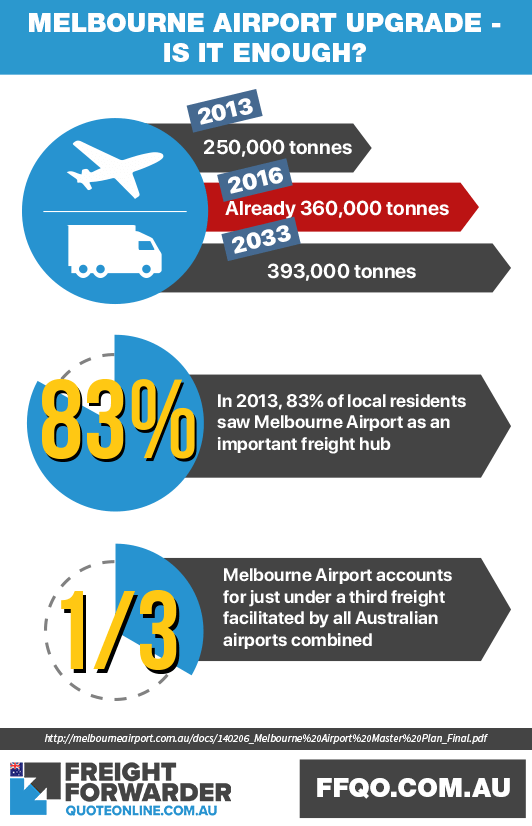
Is the Melbourne airport upgrade sufficient to sustain air cargo needs?
However, as of this year (2016), Melbourne airport already handles 350,000 tonnes of air freight per annum. Within 3 years it has already used 70% of the predicted number of tonnes for 2033. It clearly shows the demand for air freight movement has increased much faster than anticipated in 2013. Only 30% of the upgrade capacity is left for the next 17 years. This is of concern and the 2033 forecast should be checked and addressed. If growth continues at this rate, capacity will be exceeded within 2 to 5 years.
Impact to exporters and importers
An analysis of the Melbourne Airport upgrade plan of 2013 suggests a review and update is required to ensures it properly allows for the faster than anticipated growth demand in air freight. The lengthy process involved in approving any Major Developments Plans (MDPs) means the review should be started as soon as possible. Without sufficient and efficient air freight infrastructure
- increased costs caused by delays, congestion, and insufficient capacity will occur
- the growth of the air freight market will be hindered
If the 2013 upgrade plan remains unchecked and air freight growth at the airport continues at current rates, then the outlook for importers and exporters using Melbourne Airport does not look promising from 2 to 5 years’ time.
Find out more about Freight Forwarder Quote Online Australia and Freight Forwarding.
Follow us on Linkedin or a Facebook to remain updated for our upcoming blogs regarding infrastructures in Australia.
Check out our other recent articles
Latest news
Read up on the latest Australian freight forwarding news and developments:
Marine cargo insurance, should you buy it? - 28 May 2023
Aus UK FTA 2023 highlights in of the new free trade agreement - 07 Apr 2023
Types of cargo shipped via sea freight - 05 Mar 2023

Get social with us
Check us out on Facebook. Get social and like our page. Feel free to post your thoughts - we will appreciate it.
Come see our clips on our YouTube channel and subscribe so you are notified when we add new ones.
To keep up to date with the industry and read up on industry trends and developments, follow us on LinkedIn.
For quick updates, follow us on Twitter.
1300651233