Home » News »
Reefer guide and best practises when using refrigerated containers for shipping
« Previous | Next »
Our comprehensive reefer guide includes dimensions, how they work, temperature and humidity settings for reefer cargo and best practises when shipping. Reefers (short for refrigerated containers) are large climate-controlled shipping containers. They are used for transporting various commodities needing specific levels of cold and moisture to prevent spoilage and damage. They are used for transporting goods such as:
- Fresh vegetables, fruit and flowers
- Meats, poultry, fish and seafood
- Medicines, batteries and film supplies
Only reefers and reefer ships can be used for long-distance transport of goods that require specific temperatures and moisture levels. Reefers are, however, generally the better option when shipping such cargo.
Our reefer guide has the following sections:
- Reefer dimensions table
- Reefer cargo temperatures and humidity settings table
- Methods for extending reefer cargo shelf life table
- How reefers work and their major components
- Best ways to handle reefers when shipping

Reefer guide and best practices when using refrigerated containers for shipping
Types and dimensions of reefers
There are various types and sizes of reefers available. Which you choose will depend on what temperature the types of reefer cargo needs to be kept at.
For the reefer dimensions table or our reefer guide to cargo temperatures and humidity settings table.
Closed reefer
This type of reefer is the most conventional. It is a standard one-piece shipping container with an inbuilt front wall housing the temperature and humidity control equipment. Closed reefers are fully electric and self-regulate their internal climate control.
Modified Atmosphere/Controlled Atmosphere (MA/CA) reefer
These are fully-shielded, climate-controlled shipping containers that maintain oxygen constancy with an air exchange system. By maintaining the internal container ambience, MA/CA reefers minimise cargo spoilage and damage to cargo that have a moderate level of respiration.
Automatic Fresh Air Management (AFAM) reefer
Reefers of this type utilise state-of-the-art automation equipment to maintain consistent temperature levels and specific atmospheric constancy. Operating similarly to the MA/CA reefer they have an air exchanger that automatically adjusts to ensure a specific mix of oxygen, carbon dioxide and other gases. The AFAM reefer is able to greatly extend the length of time cargo can be transported and is ideal for produce that has a high level of respiration.
For our reefer dimensions table.

Three types of reefers
Reefer dimensions table
Reefers come in various sizes, and these are shown in the reefer guide table below. The common brands for standard reefer containers are Primeline, Magnum and Star Care.
Super Freezers are a special class of reefer containers that can keep temperatures as low as -65°C in 40 foot heavily insulated containers, and -70°C in smaller 10 foot and 20 foot containers.
Refer to our shipping container dimensions guide for the complete dimension and specifications of all eleven types of shipping containers.
Some notes on the headings are the door width and heights is when door is open (*) and the internal height is internal height to load line (#).
| Container | 20′ | 40′ High Cube | |||
|---|---|---|---|---|---|
| Model | Standard | Primeline | Magnum | Star Care | Super Freezer |
| Maximum payload (kg) | 27,770 | 29,790 | 29,380 | 29,750 | 29,290 |
| Width | 8′ | 8′ | 8′ | 8′ | 8′” |
| Height | 8’6″ | 9’6″ | 9’6″ | 9’6″ | 9’6″ |
| Volume (CBM) | 28 | 67 | 64 | 67 | 60 |
| Door width* (mm) | 2,290 | 2,290 | 2,276 | 2,290 | 2,278 |
| Door height* (mm) | 2,252 | 2,557 | 2,471 | 2,557 | 2,473 |
| Internal length (mm) | 5,456 | 11,599 | 11,578 | 11,599 | 11,578 |
| Internal width (mm) | 2,290 | 2,290 | 2,280 | 2,290 | 2,188 |
| Internal height# (mm) | 2,188 | 2,456 | 2,450 | 2,465 | 2,380 |
| Weight gross (kg) | 30,480 | 34,000 | 34,000 | 34,000 | 34,000 |
| Weight tare (kg) | 2,710 | 4,210 | 4,620 | 4,250 | 4,710 |
Cargo types and temperatures settings reefer guide
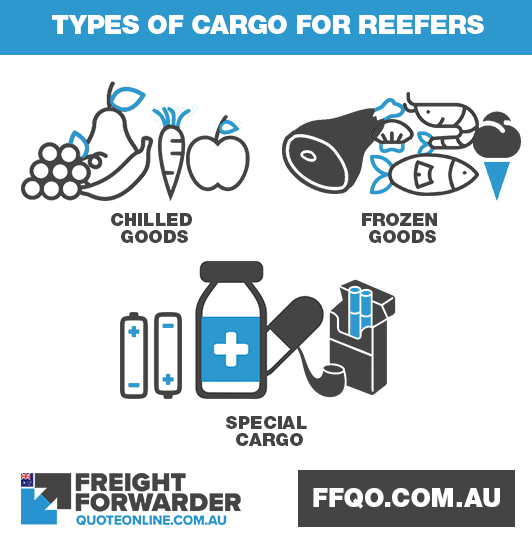
Disparate goods require disparate types of shipping in order to reach their destinations in optimal condition. Broadly, reefer cargo can be classified into one of three main types.
For the our reefer guide to cargo temperatures and humidity settings table.
Chilled goods
This includes goods that need to be kept at temperature near, but not below, their freezing points. These goods are not frozen, and include:
-
-
- Fish and seafood
- Flora and greenery
- Fruit and vegetables
- Meats and poultry
-
The freshness and longevity of these goods depend on product type and their environment. The temperature at which such products are kept must take into account at what stage of the product life cycle these goods are being transported.
It is imperative that chilled goods are transported at the precise required temperature and humidity to ensure they do not spoil. Vegetables that have high respiration rates and give off a lot of moisture and gases are typically most vulnerable to spoiling if settings are not correct.
Frozen goods
Frozen goods are those needing storage and transportation at temperatures of -20°C and below. The types of frozen goods shipped by reefers include:
-
-
- Concentrates and prepared foods
- Frozen meat, poultry and seafood
- Ice-cream, frozen yoghurts and gelato
-
The low temperatures prevent deterioration while preserving flavour, aroma, texture and quality. The cold inhibits the growth of bacteria and microbes and prevents enzyme activity and oxidation. It is crucial that the temperature in the reefer for these goods remains steady and constant at all times. Any thawing or refreezing will spoil and destroy them.
Special cargo
These are primarily non-comestible goods that nonetheless need to be kept at some specific temperature and moisture level. Special cargo includes:
-
-
- Pharmacy, medical and biological products
- Batteries, tobacco, film and camera supplies
- Volatile industrial chemicals
-
These often require special handling, and have requirements for how they must be packaged and stowed as well as specific temperature and humidity levels.
For the reefer dimensions table or our reefer guide to cargo temperatures and humidity settings table.
Types of cargo for reefers
Reefer cargo temperatures and humidity settings table
Some notes on the headings for the reefer cargo temperatures and humidity settings table are that ventilation means that air exchanged with outside atmosphere (*), dehumidification refers to if the maximum relative humidity setting is on or off (#) and the approximate shelf life is after the harvest of goods has occurred in ambient air (^).
| Commodity | Temperature degrees °C | Ventilation cbm/hr* | Humidity relative % | Dehumidify | Approximate shelf life# |
|---|---|---|---|---|---|
| Apples (fresh) | -1 to +4 | 10 to 60 | 90 to 95 | off | 1 to 7 months |
| Apricots (fresh) | -0.5 to 0 | 15 to 60 | 90 to 95 | off | 1 to 4 weeks |
| Artichokes, globe (fresh) | 0 to +2 | 0 to 15 | 90 to 95 | off | 2 to 3 weeks |
| Asparagus (fresh) | 0 to +2 | 15 to 25 | 90 to 98 | off | 2 to 3 weeks |
| Avocados (fresh) | 4 to +13 | 30 to 60 | 85 to 95 | off | 2 to 3 weeks |
| Bakery products (chilled) | 10 to +18 | 0 (closed) | 60 to 95 | on or off | Depending on commodity |
| Bakery products (frozen) | -18 or colder | 0 (closed) | – | off | 3 to 18 months |
| Bananas (fresh) | 13 to +14.4 | 25 to 60 | 90 to 95 | off | 18 to 22 days |
| Beans, green snap (fresh) | 4 to +7.5 | 20 to 30 | 95 to 98 | off | 7 to 10 days |
| Blueberries (fresh) | -1 to 0 | 0 to 10 | 90 to 95 | off | 10 to 14 days |
| Broccoli (fresh) | 0 to +1 | 20 to 60 | 90 to 98 | off | 10 to 14 days |
| Butter (chilled) | 0 to +8 | 0 (closed) | – | off | 2 to 6 weeks |
| Butter (frozen) | -18 or colder | 0 (closed) | – | off | 8 to 12 months |
| Cabbage, Chinese (fresh) | 0 to +2 | 20 to 60 | 90 to 98 | off | 2 to 3 months |
| Cabbage, early (fresh) | 0 to +2 | 20 to 60 | 90 to 98 | off | 3 to 6 weeks |
| Cabbage, late (fresh) | 0 to +2 | 20 to 60 | 90 to 98 | off | 5 to 6 months |
| Carrots, topped (fresh) | 0 to +2 | 10 to 20 | 90 to 98 | off | 1 to 9 months |
| Cassava (Yuca and Manioc) (fresh) | 0 to +5 | 10 to 20 | 85 to 90 | off | 1 to 2 months |
| Cauliflower (fresh) | 0 to +1 | 20 to 60 | 90 to 98 | off | 2 to 4 weeks |
| Cheese (chilled) | 0 to +18 | 0 (-closed) | – | off | Depending on the variety |
| Cherries, sweet (fresh) | -1 to 0 | 10 to 15 | 90 to 95 | off | 2 to 3 weeks |
| Chocolate (chilled) | 8 to +18 | 0 (closed) | 65 to 85 | on & off | 5 to 15 months |
| Cocoa butter (chilled) | 15 to +25 | 0 (closed) | – | off | 12 to 24 months |
| Coconut, dehusked (fresh) | 0 to +2 | 0 to 25 | 75 to 85 | on & off | 1 to 2 months |
| Codfish, dried, salted (chilled) | 1 to +3 | 0 (closed) | 65 to 70 | on | 12 months |
| Corn, sweet, baby (fresh) | -0.5 to +13 | 10 to 15 | 90 to 98 | off | 5 to 8 days |
| Cucumbers (fresh) | 10 to +13 | 15 to 25 | 90 to 95 | off | 10 to 14 days |
| Dates | 0 to +2 | 0 to 5 | 65 to 85 | on & off | 6 to 12 months |
| Eggplants, aubergine (fresh) | 8 to +12 | 10 to 15 | 90 to 95 | off | 1 to 2 weeks |
| Eggs, dried, whole solids (chilled) | 4 to +10 | 0 (closed) | – | off | 1 to 2 years |
| Eggs, with shell (chilled) | -1 to +3 | 0 (closed) | – | off | 5 to 6 months |
| Figs (fresh) | -0.5 to 0 | 0 to 5 | 85 to 90 | on | 7 to 10 days |
| Fish (frozen) | -18 or colder | 0 (closed) | – | on | 4 to 12 months |
| French fries, Potato wedges (frozen) | -18 or colder | 0 (closed) | — | off | 12 to 24 months |
| Fruit (frozen) | -18 or colder | 0 (closed) | – | off | Depending on the commodity |
| Garlic (fresh) | -3 to +1 | 0 to 5 | 60 to 70 | off | 6 to 7 months |
| Ginger (fresh) | 12 to +14 | 10 to 15 | 65 to 75 | off | 2 to 3 months |
| Grapefruit (fresh) | 10 to +15 | 10 to 50 | 85 to 90 | off | 1 to 2 months |
| Garapes, table (fresh) | -1 to 0 | 10 to 15 | 85 to 95 | off | 1 to 5 months |
| Honey, strained (chilled) | 10 to +20 | 0 (closed) | – | off | 1 to 2 years |
| Ice cream, dairy desserts (frozen) | -26 or colder | 0 (closed) | – | off | 4 to 6 months |
| IQF, individually quick-frozen products (frozen) | -18 or colder | 0 (closed) | – | off | Depending on commodity |
| Juice, concentrate, fruit (frozen) | -18 or colder | 0 (closed) | – | off | 1 year |
| Kiwifruit, green, golden (fresh) | -0.5 to +5 | 20 to 40 | 90 to 95 | off | 2 to 3 months |
| Lemons (fresh) | 10 to +14 | 15 to 25 | 85 to 95 | off | 1 to 3 months |
| Lettuce (Iceberg) (fresh) | 0 to +1 | 20 to 50 | 90 to 98 | off | 2 to 3 weeks |
| Limes (fresh) | 8 to +12 | 15 to 25 | 85 to 90 | off | 2 to 5 weeks |
| Lychees (fresh) | 2 to +6 | 10 to 15 | 90 to 95 | off | 3 to 5 weeks |
| Mandarins, Clementines, Tangelos, Tangerines (fresh) | 4 to +8 | 15 to 25 | 90 to 95 | off | 3 to 8 weeks |
| Mangoes (fresh) | 8 to +14 | 25 to 30 | 85 to 95 | off | 2 to 4 weeks |
| Margarine (chilled) | 0 to +8 | 0 (closed) | – | off | 4 to 5 months |
| Meat (chilled) | -2 to -1 | 0 (closed) | – | off | 1 to 8 weeks |
| Meat (frozen) | -18 or colder | 0 (closed) | – | off | 6 to 18 months |
| Melons (Cantaloupe and Charentais) (fresh) | 2 to +5 | 25 to 30 | 90 to 95 | off | 1 to 2 weeks |
| Melons (Gallia), Orange flesh (fresh) | 7 to +8 | 25 to 30 | 90 to 95 | off | 2 to 3 weeks |
| Melons (Water and Honeydew), Pie de sapo (fresh) | 9 to +12 | 25 to 30 | 85 to 95 | off | 2 to 3 weeks |
| Milk, dried (fresh) | 7 to +21 | 0 (closed) | – | off | 6 to 9 months |
| Mushrooms (fresh) | 0 to +1 | 0 to 10 | 90 to 98 | off | 5 to 7 days |
| Onions, bulbs (fresh) | 0 to +8 | 10 to 40 | 65 to 75 | on | 2 to 9 months |
| Oranges (fresh) | 2 to +10 | 15 to 25 | 85 to 90 | off | 1 to 3 months |
| Papayas (fresh) | 7 to +13 | 25 to 30 | 85 to 90 | off | 1 to 3 weeks |
| Peaches, nectarines (fresh) | -0.5 to 0 | 15 to 25 | 90 to 95 | off | 2 to 5 weeks |
| Pears (fresh) | -1.5 to 0 | 15 to 25 | 90 to 95 | off | 1 to 8 months |
| Peas, snow, sugar snap (fresh) | 0 to +1 | 15 to 25 | 90 to 98 | off | 1 to 2 weeks |
| Peppers, bell sweet, chili (fresh) | 7 to +10 | 10 to 15 | 90 to 95 | off | 2 to 3 weeks |
| Persimmon, Kaki (fresh) | -1 to +1 | 15 to 25 | 85 to 95 | off | 1 to 3 months |
| Physalis, Cape Gooseberries (fresh) | 10 to +16 | 0 to 15 | 65 to 85 | on & off | 3 to 6 weeks |
| Pineapples (fresh) | 7 to +13 | 15 to 25 | 85 to 90 | off | 2 to 3 weeks |
| Plantains (fresh) | 9 to +13.5 | 20 to 25 | 85 to 95 | off | 1 to 4 weeks |
| Plums (fresh) | -0.5 to 0 | 10 to 25 | 90 to 95 | off | 2 to 5 weeks |
| Pomegranates (fresh) | 5 to +9 | 10 to 25 | 90 to 95 | off | 2 to 3 months |
| Potatoes, for processing (fresh) | 10 to +15 | 10 to 50 | 85 to 95 | off | 2 to 12 months |
| Potatoes, seed (fresh) | 4 to +8 | 10 to 25 | 65 to 90 | on & off | 2 to 6 months |
| Potatoes, sweet (fresh) | 12 to +16 | 0 to 30 | 80 to 95 | on & off | 4 to 6 months |
| Potatoes, table (fresh) | 5 to +10 | 0 to 50 | 85 to 95 | off | 2 to 12 months |
| Poultry (fresh) | -18 or colder | 0 (closed) | – | off | 6 to 16 months |
| Radish (fresh) | 0 to +5 | 0 to +5 | 90 to 95 | off | 1 to 4 weeks |
| Seafood, Shrimps, Mussels, Octopus, Squid (frozen) | -18 or colder | 0 (closed) | – | off | 6 to 12 months |
| Squash, summer, soft rind (fresh) | 5 to +10 | 0 to 10 | 90 to 95 | off | 10 to 14 days |
| Squash, winter, hard rind pumpkins (fresh) | 10 to +13 | 0 to 60 | 60 to 85 | on & off | 5 to 8 weeks |
| Strawberries (fresh) | -0.5 to 0 | 10 to 15 | 90 to 95 | off | 3 to 8 days |
| Taro, Malanga (fresh) | 7 to +13 | 10 to 15 | 85 to 90 | off | 2 to 5 months |
| Tomatoes (fresh) | 7 to +15 | `5 to 30 | 65 to 85 | on & off | 1 to 4 weeks |
| Turnips (fresh) | 0 to +4 | 0 to 10 | 90 to 95 | off | 4 to 5 months |
| Vegetables (frozen) | -18 or colder | 0 (closed) | – | off | Depending on commodity |
| Wine | 12 to +15 | 0 (closed) | – | off | 1 to several years |
| Yams | 16 to +20 | 0 to +10 | 65 to 85 | 16 to +20 | 2 to 5 months |
Reefer guide to methods for extending reefer cargo shelf life table
Some types of cargo may have their shelf life extended and are listed in our reefer guide table below.
| Commodity | Methods for extending shelf life |
|---|---|
| Apples (fresh) | CA containers often employed |
| Apricots (fresh) | MA /CA containers often employed |
| Asparagus (fresh) | MA packaging or CA containers often employed |
| Avocados (fresh) | MA /CA containers often employed |
| Bananas (fresh) | MA packaging (Banavac) or CA containers often used |
| Blueberries (fresh) | MA packaging (Banavac) or CA containers often used |
| Cherries, sweet (fresh) | MA packaging often applied |
| Grapefruit (fresh) | Sometimes carried at °8 though subject to chilling injury below +10°C |
| Lemons (fresh) | Up to 4 weeks at +5 to 9°C is tolerated by most varieties, though chilling sensitive |
| Limes (fresh) | Often carried at 7°C though subject to chilling injury below +8°C; dehumidification sometimes applied to reduce mould growth |
| Melons (Cantaloupe and Charentais) (fresh) | MA packaging often applied |
| Melons (Galia), Orange flesh (fresh) | MA packaging often applied |
| Peaches, Nectarines (fresh) | MA/CA containers often employed |
| Peas, Snow, Sugar snap (fresh) | MA packaging or CA containers often used |
| Pineapples (fresh) | Often carried at +6.5°C though subject to chilling injury below +7°C |
| Plantains (fresh) | MA packaging (Banavac) or CA containers often used |
| Plums (fresh) | MA/CA containers often employed |
Reefer guide on how refrigerated shipping containers work
Reefers are called bottom air delivery units because they push cooled air up from the floor using T-shaped decking. In this way, the shipping container ensures there is a constant air flow at sufficient strength to hold the temperature at the required level for the entire journey. Further, should external temperatures be extremely low or high, reefers self-regulate and make constant adjustments to maintain the requisite atmosphere within the container. The reefer’s temperature range covers -35 degrees to 35 degrees Celsius.
Difference between reefers and general shipping containers
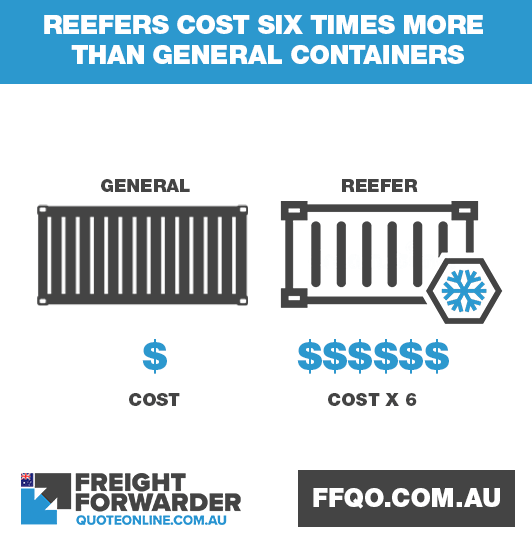
The biggest difference between reefers and general shipping containers is the temperature control function. Normal containers are used to ship dry goods and do not have or need such a system. The two also differ in terms of size, design, power generation and electrical distribution equipment. Reefers are smaller and contain individually powered refrigeration units. They cost around six times more than a conventional container because they come with additional insulation and a power plant.
Difference between reefers and reefer ships
Reefers in general are better suited than reefer ships for most shipping situations. The main reasons for their advantages are:
-
-
- Self-contained refrigerated units, so cold storage is not required at destination port
- Available in various sizes and shapes to provide economical transport volumes
- Strong, hardwearing and suitable for any weather conditions
- Easy to load and unload on specialised reefer container ships
-
Reefers cost six times more than a general shipping containers
Reefer guide to components in refrigerated shipping containers
Reefers eliminate the heat respiration from products, thereby maintaining temperature stability. Moisture in the air is also controlled in reefers, thus ensuring optimal atmospheric conditions for the cargo. To understand how this is done we need to review the relevant reefer elements.
Generator set
The generator set (genset) is what powers the reefer, and generally runs on both electricity and fuel (diesel, petrol and gas). They are set to use power from the cargo vessel and have the fuel option as a backup. The genset can be attached to the shipping container (clip-on genset) or can be chassis-mounted to the container’s underside (underslung genset).
Humidity control
Maintaining the relative humidity in a reefer is crucial for transporting chilled, frozen and special goods safely. Dry air may result in the loss of too much water from produce; however too much humidity may result in mildew or bacterial growth. The reefer’s climate control system ensures optimal conditions for special goods such as medications, pharmaceutics, electronic and mechanical goods and components. Dry packing is assured, and consumables are safe from mould and moisture damage. The reefer’s range for dehumidification is 60% to 95% relative humidity.
Temperature control
Reefers are cooled by either water or air, although the latter is more dominant now due to the cost of water coolant systems. Dispersed heat from the cooler unit is removed by propeller or centrifugal fans. Refrigerant gases are sucked in via a small motor which compresses and liquefies them, releasing the heat to the encircling air. This then moves into a condenser, then an evaporator where excess water from the cooling process is drained to the outside.
Global Positioning System
A global positioning system (GPS chip) is installed on each reefer to ensure containers are not lost en route. Shipping containers may spend time in many ports and be transported in various ways before offloading at their destination. Cargo security is vital, and the GPS chip ensures the whereabouts of each refrigerated shipping container is known.

Major reefer components
Reefer guide to how freight forwarders handle reefer cargo
Reefer cargo needs careful handling throughout the transportation cycle, from packaging to stowing to processing. Lack of care can negatively affect shelf life, characteristics, grade and look of goods. It is vital to consider the kind of equipment, the amounts and weights of products, the duration of travel, and relevant regulations in force throughout the journey. Below are the various freight handling stages and the correct methodology for each.
Pre-shipment handling
The freight forwarder needs to ensure the accuracy of information of the reefer goods being shipped. This includes confirming the:
-
-
- Product volume and weight
- Departure and destination ports
- Type of packaging (boxes, drums, and palettes)
- Temperature and humidity requirements
- Any other special handling needs
-
Further, the freight forwarders generally take care of other matters, such as confirming the vessel and container identification, shipment date coordination, making sure sizes and weights are as legally required, and that all other conditions are met and correct.
Pre-cooling
Reefers do not chill the products; they just hold the goods at their pre-cooled temperature level. The freight forwarders must, therefore, make sure chilled or frozen goods are already cooled to the necessary temperature prior to packing into the container. Similarly, the container must be pre-cooled so there is no surface thawing and freezer burn. This occurs when the container and cargo have temperatures that are disparate. To maintain temperatures goods are loaded via a cold tunnel, which is a tightly insulated duct that ensures warm, humid air cannot enter the container.
Packaging and stowing
Correct packaging and stowing needs to be such that it protects cargo from mishandling and inclement weather. Packaging needs to be sufficiently robust to bear the mass of other cargo stacked on top of it, and be able to hold up the goods above it. When freight is stowed there must be sufficient air circulation and flow. However, not all cargo types require the same or even similar stowage. Chilled fresh produce requires good air access and circulation via the packaging, whereas frozen goods need stacking in block formation, with no gaps.

How expert freight forwarders handle reefer cargo
Have any questions on our reefer guide?
At Freight Forwarder Quote Online Australia our shippers use best practice for reefer shipping. We make sure storage and stowage is correct, avoiding the danger of product deterioration and knockback at destination. Our shippers also make certain:
-
-
- Goods are well-packed and immovable within packaging
- Required cargo temperature and moisture levels are activated
- Cargo is correctly pre-cooled as required
- Appropriate air circulation and settings are right
- Cargo is fully insured and covers the correct value
-
Contact us if you need help with our reefer guide
If you need expert help with our reef guide, feel free to contact us online or message via our Facebook page. We’re more than happy to help you when importing or exporting your refrigerated goods from Australia with reefers.
Check out our other recent articles
Latest news
Read up on the latest Australian freight forwarding news and developments:
AI in freight forwarding and the changing Australian workforce - 10 Aug 2026
Marine cargo insurance – Why do you need it? - 23 Jul 2026
What is the Australian Trusted Trader program (ATTP) - 24 Jun 2026

Get social with us
Check us out on Facebook. Get social and like our page. Feel free to post your thoughts - we will appreciate it.
Come see our clips on our YouTube channel and subscribe so you are notified when we add new ones.
To keep up to date with the industry and read up on industry trends and developments, follow us on LinkedIn.
For quick updates, follow us on Twitter.
1300651233