Home » News »
Regional Comprehensive Economic Partnership (RCEP): An attack against TPP?
« Previous | Next »
22- 29 April, Perth hosted the twelfth round of negotiations towards a major new free trade agreement – the Regional Comprehensive Economic Partnership (RCEP).
This is a trade agreement between ASEAN nations and its trading partners namely:
- Australia
- China
- India
- Japan
- South Korea
- New Zealand

Participating countries of the Regional Comprehensive Economic Partnership (RCEP)
It is said to herald the next phase in Asian economic cooperation. However, some are saying that it is actually China’s response to the TPP – a trade agreement led by the US.
Is this a fact? Read on to learn more about it.
Key interest and benefits of the Regional Comprehensive Economic Partnership (RCEP) to Australia and other participating nations
16 of the RCEP participating countries account for almost half of the world’s population, which is almost 30% of the global GDP and over 25% of the world exports. This also covers nine of Australia’s top 12 trading partners namely:
- China
- Japan
- South Korea
- India
- New Zealand
- Singapore
- Indonesia
- Malaysia
- Thailand
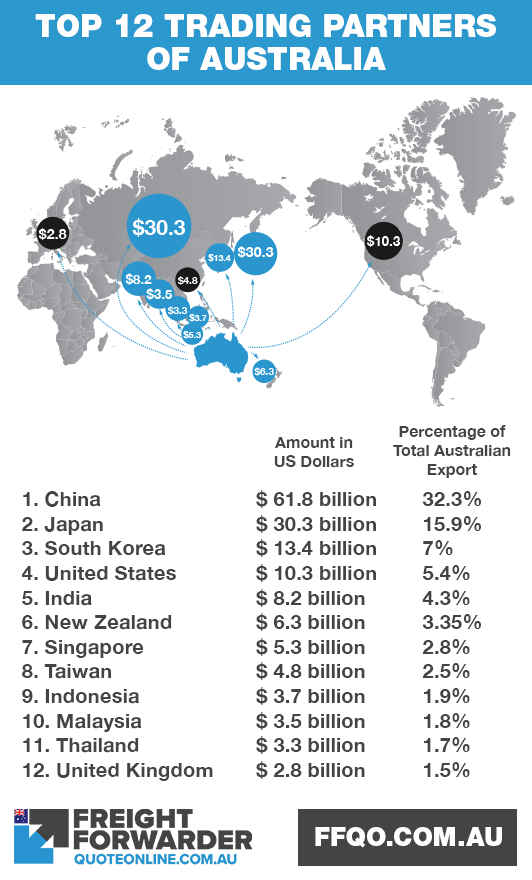 Top 12 trading partners of Australia
Objective of the RCEP
The objective of this RCEP trade agreement is to achieve a modern, comprehensive, high-quality and mutually beneficial economic partnership agreement that will cover trade in goods, trade in services, investment, economic and technical cooperation, intellectual property, competition, dispute settlement and other issues.”
Ultimately, RCEP aims to provide pathways to free trade area throughout the Asia-Pacific. It provides a basis for a more open trade and investment in this region and addresses concerns about overlapping bilateral agreement through regional liberalisation.
This is in line with the Australian government’s strategy for lowering trade barriers and securing improved market access for Australian exporters of goods and services, and for Australian investors.
Benefits of RCEP to Australia
In the published media release of The Hon Steven Ciobo MP last April 22, he stated that RCEP will:
- Establish a rules-based framework for trade and investment in the region and encourage countries to work collaboratively to promote economic growth and address problems
- Provide increased opportunities for Australian industry to participate in regional supply chains
- Assist Australian business to access regional technology and capital to boost jobs and innovation in Australia
Reduced duties on items especially from China and India
Australia has much to gain from RCEP, especially with 70% of its two-way trade and 70% of its goods and services exported to participating ASEAN nations having duties reduced or eliminated.
Under the RCEP, China and India is agreeing to remove duties of up to 42.5% of items while Japan, South Korea and Australia have decided to eliminate duties of up to 80% of items for India.
More jobs and growth into Australia
In addition to reduced duties, RCEP is also expected to drive jobs and growth into Australia as it creates more opportunities for local businesses to provide goods and services to the region’s rapidly growing middle classes.
In his published article Steven said,
“Removing trade barriers remains a key priority for the Coalition in Australia’s transitioning economy. Any agreement that expands trade and investment adds to regional prosperity and benefits Australia as new jobs are created.”
Intensified negotiations to finalise RCEP
The signing of the Trans Pacific Partnership (TPP) agreement has intensified the negotiations for RCEP which covers similar areas such as:
- Goods
- Services
- Investment
- Economic and technical cooperation
Thus, RCEP participants are pushing the same focused negotiation to speed up the process with the the last two negotiations scheduled to be held in June at New Zealand and September at Laos.
Major issues revolving around RCEP
Just like other “secretive” trade agreements, RCEP is facing the scrutiny of many industries. Some of which includes the following:
- Potential monopoly in the pharmaceutical industry
- Benefits to the grain industry
- Issues with intellectual property rights
RCEP and the pharmaceutical industry
A leak in the proposed intellectual property chapter of RCEP states a provision that, if agreed to, would “extend to pharmaceutical monopolies in several low and middle income negotiating countries”.
This is the statement revealed to by Dr Belinda Townsend, spokesperson for Public Health Association Australia (PHAA)
In her statement she said, “If India were to agree to these provisions, its generic industry could be delayed in providing cheaper lifesaving medicines for the world’s poor, which could have fatal consequences.”
As a result, PHAA urges the government to reject the inclusion of Investor State Dispute Settlement (ISDS) in the RCEP.
However, advocates of Free Trade Agreements, such as the Geneva Network, say otherwise.
RCEP and the grain industry
Whilst the pharmaceutical industry is in dispute whether or not to give RCEP a nod, the grain industry is giving it its full support.
Dr. Cheryl Kalisch Gordon, manager of trade and market access with GrainGrowers, was part of the 12th round of RCEP negotiations in Perth this April. Below is a summary of what she had to say.
Approximately 65% of Australian grain exports are transported to countries involved in RCEP. 8 out of Australia’s top 10 wheat importers, which includes all of the top five, are in participating in it. Thus it is very important to the grain industry.

Top 5 wheat importers of Australia
“With the RCEP, we are the key grain exporting nation in the group and already have important markets. This is an opportunity to shore up relationships and streamline processes.
“We can’t rely solely on our freight advantage into south-east Asia, we’ve seen competitors move grain here cost effectively this season and while sea freight rates will go up again, the long term picture is that there will be more efficient sea freighting systems in place.
“These trade deals can help secure future markets for our industry.”
Read the complete article discussing Cheryl’s view on RCEP and the grain industry.
Benefits of RCEP to the Australian grain industry
Amidst Australia having existing trade agreements with most of the RCEP nations, it is still important to try and minimise non-tariff costs, especially if it means a chance to reduce operational costs.
Cheryl said that they are pushing for reform of several technical market access issues and primary sanitary as well as phytosanitary (plant health when trading) requirements. One of which is the uniform testing of grain to provide greater certainty in the export of Australian grain. If added into RCEP, this would minimise the issue of different testing results making it easier for Australian grain producers to do business.
RCEP and intellectual property rights
RCEP, just like TPP, is receiving its own share of bashing from groups supporting the protection of intellectual property rights. In a leaked draft of RCEP, anti-RCEP claims it states inflexible copyright standards and extravagant claims to the following:
- Copyright terms and enforcement
- ISP liability
- Digital rights management
- Trade secrets
Read the complete article here.
More than a trade agreement, it’s a battle for control of the Pacific trade
With both RCEP and TPP coming to a close and many are doing their best to challenge its implementation, some analyst say that it is more than a trade agreement. Rather it has become a geopolitical battle between China and the US.
China has definitely awakened. It making its influence felt in almost all avenues, especially in the field of trade. The US knows of this and is defending its territory in the Pacific realm to the best that it can with TPP.
This was boldly stated in President Obama’s opinion piece published in the Washington Post on May 1, 2016.
“America should write the rules. America should call the shots. Other countries should play by the rules that America and our partners set, and not the other way around.
“The world has changed. The rules are changing with it. The United States, not countries like China, should write them. Let’s seize this opportunity, pass the Trans-Pacific Partnership and make sure America isn’t holding the bag, but holding the pen.”
This is obviously a remark against the RCEP being pushed by China in Asia Pacific region.
Could you blame him? Not if you are seeing this growth of trading influence of China around the globe.
 Who between these two giants will win?
The growth of China as an emerging superpower is inevitable. The next question for Australia is how it will play its game with both China and the US. Should it make a stand or continue juggling the ball between these two giants?
Why not a unified trade agreement?
Wang Huiyao, the president of the Center for China and Globalization, and an advisor to the Chinese government, recommends a unified trade agreement rather than having a world divided by different “trade blocs”.
“The two sides should stop creating trade bottlenecks and join hands for the expansion of free trade,” Wang stated in his publish statement in Voice of America (VOA).
He further added that both China and the US have a lot to gain if they worked within one trade regime.
Given this information, would the RCEP even proceed as planned? Or do we see China and India joining TPP?
That’s a different discussion altogether. For now, let us hope that RCEP negotiations would proceed in favour of the participating countries, rather than one nation.
Find out more about Freight Forwarder Quote Online Australia and Freight Forwarding or follow us on our Linkedin profile to remain updated for our upcoming blogs regarding for you to remain posted of the recent Trade Agreement, freight and customs news. Otherwise, call us at 1300651233.
Check out our other recent articles
Latest news
Read up on the latest Australian freight forwarding news and developments:
Marine cargo insurance, should you buy it? - 28 May 2023
Aus UK FTA 2023 highlights in of the new free trade agreement - 07 Apr 2023
Types of cargo shipped via sea freight - 05 Mar 2023

Get social with us
Check us out on Facebook. Get social and like our page. Feel free to post your thoughts - we will appreciate it.
Come see our clips on our YouTube channel and subscribe so you are notified when we add new ones.
To keep up to date with the industry and read up on industry trends and developments, follow us on LinkedIn.
For quick updates, follow us on Twitter.
1300651233