Home » News »
Why fuel shortage in Singapore from Iran conflict means higher Australian sea freight costs?
« Previous | Next »
If you have noticed a sudden spike in Australian shipping surcharges or unexpected delays in your latest arrivals, the significant part of the cause comes from Singapore. As the world’s largest refuelling station for cargo ships, Singapore’s current fuel inventory crisis is creating a ripple effect across the Pacific Ocean. This shortage is driving up the cost of moving goods to Australia and forcing a total rethink of shipping logistics for the remainder of 2026.
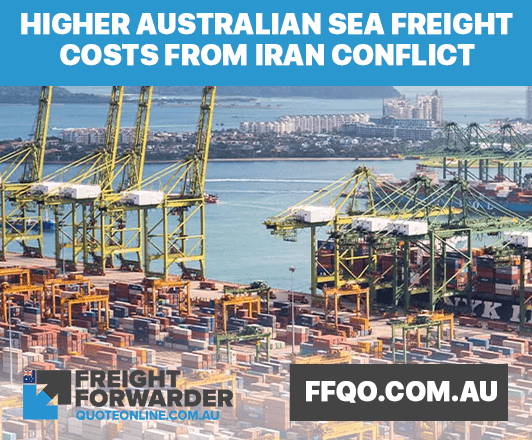
Higher Australian sea freight costs from from Iran conflict fuel crisis 2026
Dry port crisis
For the first time in years, Singapore’s fuel supply is critically tight. Usually, they have plenty in reserve, but right now, the buffer is thinning faster than it can be replaced.
Stockpile warning
Data from Enterprise Singapore shows that if residual fuel oil stocks fall below 20 million barrels, the market enters a danger zone. We are seeing that buffer disappear.
Wait times extending
Ships used to pull in and refuel immediately. Now, lead times for VLSFO (very low sulfur fuel oil) have extended to 10 to 12 days. If that wait stretches past 14 days, expect shipping delays to Australia to follow and get much worse.
Cause
Conflict in the Strait of Hormuz has cut off more than half of Singapore’s usual supply. Meanwhile, Fujairah in the United Arab Emirates has become unusable due to the Iran war. This forces a significant part of global shipping to fuel up in Singapore.
How Singapore is resolving fuel crisis
Singapore is not going to run dry tomorrow, but the patchwork solutions being used to keep it running are expensive and unpredictable.
Global resupply shift
Suppliers are filling the Middle East gap by shipping fuel in from Brazil. This keeps the tanks from hitting zero, but the much longer journeys add significantly to the final cost.
Atlantic refineries working overtime
Refineries in the Atlantic Ocean are ramping up production to send fuel eastward, capturing higher profits but creating longer lead times for the fuel to actually arrive.
Cargo fleet as fuel shuttles
Some fleets are now abandoning their usual cargo routes to move fuel directly from the US to Singapore. This shuttle service is very unusual for the industry. It highlights a global shipping system that is currently stretched to its limit.
New refuelling stops
Major ships are diversing their refuelling stops to include Port Klang in Malaysia and Port Colombo in Sri Lanka. This strategy helps operators avoid the ten-day wait times currently plaguing Singapore. The shift keeps cargo moving toward Australian shores, but it does little to lower the high price of fuel.
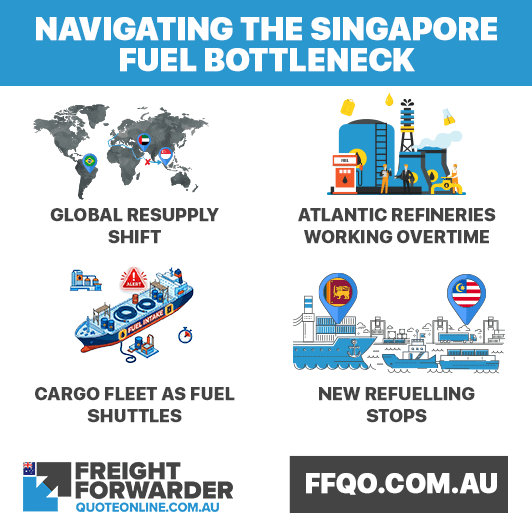
How Singapore is resolving fuel crisis in 2026
Massive price spike
When supply goes down, prices go up. Between February and March 2026, fuel prices nearly doubled, peaking near $1,000 per tonne.
While prices have dipped slightly, they remain about 70% higher than they were before the conflict began. This has forced major carriers like MSC, Maersk, CMA CGM, ONE, and Hapag-Lloyd to keep their Emergency Fuel Surcharges active. If Singapore’s supply tightens further, these surcharges will likely be revised upward again.
Why shipping deliveries arriving late
Shipping companies are not just paying more; they are changing how they move to save every drop of fuel.
Slow steaming
Carriers now prefer slow steaming to reduce their total fuel spend. This tactic mirrors a driver dropping their speed to 80km/h on a fast highway to save petrol. It effectively cuts costs for the ship owner but results in much longer wait times for Australian businesses.
Quiet schedule tweaks
Ships operators are frequently skipping Australian port calls to make up for time lost during refuelling delays. These port omissions mean your cargo might be unloaded in a different city or even a different country. This forced detour creates a massive backlog as local transport providers struggle to retrieve your goods.
Can ships refuel somewhere else?
Ship operators are re-evaluating their refuelling strategies as Singapore’s fuel stocks remain critically low. Seeking fuel regionally in Port Klang or Port Hong Kong allows ships to maintain their schedules, yet this strategy is not a simple solution. These alternatives are becoming increasingly crowded and expensive as global demand shifts away from the Port of Singapore.
Malaysia
Port Klang and Port Tanjung Pelepasis are the main alternatives at this stage. However, because it is right next to Singapore, it is also seeing a massive surge in demand and longer wait times.
Hong Kong and South Korea
These are world-class hubs, but they are further north. For a ship already halfway to Australia, turning back to the Port of Hong Kong or Ports of Busan and Incheon will make for a costly detour that adds days and cost to the delivery.
China
While China has fuel, they often prioritise their own massive fleet first, leaving limited spare supply for international ships heading to our shores. The Ports of Shanghai, Ningbo-Zhoushan, Shenzhen, Guangzhou, Qingdao, and Tianjin are closer than those in South Korea.
Tips for Australian importers to manage the sea freight price spike
Rising fuel prices are forcing shipping lines to implement aggressive Emergency Fuel Surcharges. These extra fees appear directly on your freight invoices and can add thousands of dollars to a single shipment. Higher bunker costs in Singapore essentially mean that importing the same volume of goods now requires a significantly larger logistics budget. If you are waiting on stock, do not expect things to get back to normal next week.
Plan for delays
Standard shipping windows no longer provide a reliable buffer for Australian arrivals. Local businesses should add at least 14 to 21 days to their usual lead times to account for refuelling bottlenecks in Singapore. This extra time allows you to manage customer expectations and prevents stockouts during critical sales periods.
Budget for surcharges
Fuel surcharges will likely remain elevated for the remainder of 2026 due to the ongoing supply strain. Importers need to factor these fluctuating “emergency” levies into their landed cost calculations immediately. Accurate budgeting now will help you protect your profit margins as shipping costs continue to shift.
Talk early
Early communication with your freight forwarder is the most effective way to secure vessel space before the next price hike. Forwarders can often identify alternative routes or suggest carriers that are bypassing the most congested hubs. Securing your booking weeks in advance ensures your cargo stays on the move even as global fuel inventories tighten.
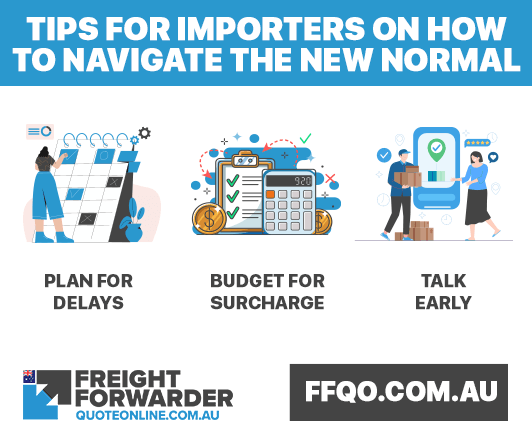
Tips for importers on how to navigate the 2026 fuel crisis
Protect your bottom line
Volatility is the new normal while Singapore’s fuel reserves remain at a dangerous low. Low-cost quotes are often a gamble that ends in expensive surcharges and broken promises. You cannot afford a partner who is waiting and seeing while your profit margins evaporate.
Smart business owners are walking away from reactive logistics. These leaders are choosing partners who treat VLSFO lead times and schedule tweaks as a frontline priority. Finding a forwarder who actually does this homework is the only way to shield your margins from a market that is currently showing zero mercy.
Let’s talk.
Try our online instant sea freight quote tool and get free and unlimited quotes. Learn more about us on social media and follow us on our LinkedIn or Facebook page. You’re welcome to call us on 1300651233 to discuss your types of cargo you need shipped.
Check out our other recent articles
Latest news
Read up on the latest Australian freight forwarding news and developments:
AI in freight forwarding and the changing Australian workforce - 10 Aug 2026
Marine cargo insurance – Why do you need it? - 23 Jul 2026
What is the Australian Trusted Trader program (ATTP) - 24 Jun 2026

Get social with us
Check us out on Facebook. Get social and like our page. Feel free to post your thoughts - we will appreciate it.
Come see our clips on our YouTube channel and subscribe so you are notified when we add new ones.
To keep up to date with the industry and read up on industry trends and developments, follow us on LinkedIn.
For quick updates, follow us on Twitter.
1300651233