Home » News »
Importing boat to Australia checklist including tips and guidelines
« Previous | Next »
When importing boat into Australia, this checklist with its tips and guidelines will help you successfully navigate this large and complex commitment. We recommend you read this carefully and make sure you consider all the points covered. Further, we suggest you carefully investigate what’s involved in this process before committing to purchase an overseas boat for import into Australia.

Checklist for importing boats to Australia including tips and guidelines
List of items to check off when importing a boat into Australia
Once all the points on the list have been marked off, your vessel can be sent to Australia.
Boats with trailers need an import approval
If your boat has a trailer – which is typical of yachts – you need this. The requisite import permit is essential to take delivery of a boat with trailer in Australia. The import permit for the trailer is required prior to landing in Australia. This permit is available by application to the Department of Infrastructure.
This permit for your trailer’s import into Australia has to be approved prior to the boat’s arrival. If this is not done, your vessel will be denied egress from the harbour. This will cost you a lot of money in mooring fees in the period until the problem is resolved.
Planning and forward action will avoid this problem. It is solely your own responsibility to ensure your vessel and trailer are covered by the necessary permit prior to shipping.
Boats with wooden cradles need fumigation or be destroyed
Unless your vessel has a trailer, a support rack will be needed for carriage on any ship. Your freight forwarder can arrange the building of a bespoke rack for your vessel. This would be made from steel or wood, according to your boat’s configuration. Should your vessel already have a support rack or you are having one custom-made, note that it must be made of steel or ISPM15-compliant timber. Also remember that most timber racks will need to be fumigated or destroyed prior to being available from quarantine. The fees for this are generally additional to your freight forwarder’s charges.

Boats trailers and wooden cradles require special actions when importing to Australia
Ensure GST and duty payable are correct on the imported boat
Import GST and duties are added to your vessel’s shipping costs. GST is 10% of the price paid for the vessel, which is validated by the Bill of Sale. Duty charged depends on where the vessel was built, which is shown by its Certificate of Origin. Vessels built in the US and shipped to Australia are tax-exempt provided they hold a proper Certificate of Origin.

Pay correct GST and duty when importing boat to Australia
Through cleaning required when importing boat to Australia
It is vital the vessel be immaculate internally and externally. Any dust, mud or dross on the trailer must be sluiced away by high-pressure hose. The vessel’s exterior must be pristine, and clear of any biologic substances such as plant, algae or parasitic matter. The vessel must be scrubbed and vacuum-cleaned to ensure there is no grime, vegetation or marine matter internally, including machinery spaces and openings throughout the boat.
Used boats are always thoroughly inspected
All vessels that are not new are cordoned off and carefully checked by Australian Biosecurity as soon as they arrive. This examination is what decides the vessel’s level of sterility and it’s impossible to predict the result until after the inspection has been completed. For this reason, freight forwarders can’t provide a forward estimate for cleaning. More examination and cleansing may be needed, and this will increase the amount required to import the vessel.
Costs of quarantining and cleaning can be minimised
The amount required to cover isolating and cleansing a vessel cannot be estimated ahead of its shipment. This is because the precise state the boat is in cannot be known until it arrives at its destination in Australia. Freight forwarders will generally charge one fee for examination, but it is important you investigate this yourself. If, during the examination, there are matters found that need to be addressed, any cleansing and/or sanitising of the vessel will attract an extra charge.
Possible washing cost at loading port
A grimy vessel may well not be accepted for loading onto the cargo ship. Having the boat cleaned so it will be acceptable will add to the charges you will have to cover at port of origin. We suggest you ensure the vessel’s vendor does all the necessary cleaning at the point of origin. Insist that they provide you with photos and video coverage of the major areas of the boat. These include the boat’s exterior, openings and machinery areas.

Cleaning and washing checklist when importing boat to Australia
Preparation of your boat for shipping when importing to Australia
It is worthwhile eliminating any items that are adding to the aggregate dimensions of your vessel. These include diving boards, radar equipment, removable bridges, keels, rudders and spars. The more you can reduce the size of your vessel, the smaller the amount you are likely to have to pay. All coverings should be latched down and well-sealed to ensure water cannot cause the hatch to open and damage the vessel’s interior.
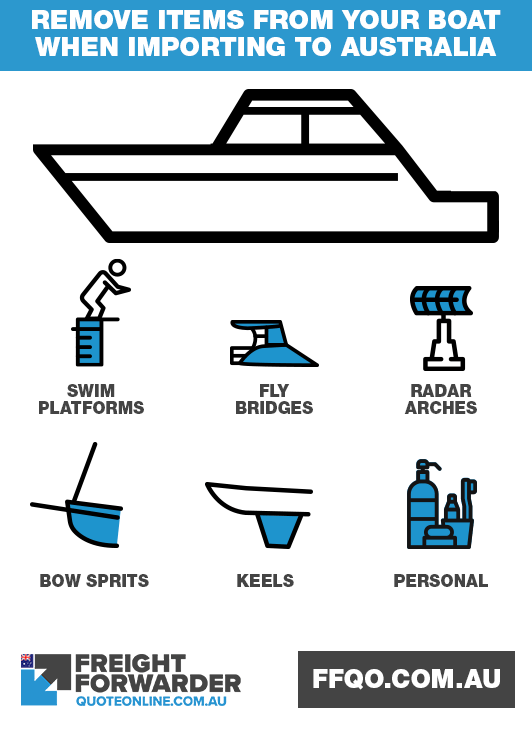
Remove items from your boat when importing to Australia
Preparing the inside your boat
Ensure everything, including doors and coverings, have been secured. The open ocean has enormous power and anything not locked down can cause a lot of harm. There should be no personal goods remaining on the vessel. All drainage points need to be checked. The bilge needs to be completely empty, otherwise it will be an issue when the vessel arrives at the point of inspection in Australia. All batteries need to be detached and the wiring tied off to ensure no contact is possible. All tanks (fuel and water) need to be as empty as possible; any contents in a tank must be below 1/4-full. If your vessel is being transported over the winter, all water needs to be emptied from pipes, pumps and all machinery, including aircons.
Air conditioning and refrigeration may need degassing
Vessels with air conditioning and refrigeration must comply with the Ozone Protection Act. Further, should this equipment be of substantial size or used commercially, an equipment licence is likely to be required.
Equipment installed more than 12 months ago; utilised solely for personal applications prior to importation, and brought into Australia for personal use only, may be exempted from the above. Further, exemptions may also apply if the air conditioning and refrigeration uses less than 25 kilos of HFCs, PFCs SF6 or NF3 equipment over a twelve month period.
If the exemptions cited above do not apply to your air conditioning and refrigeration, they will need to be degassed and decommissioned before being shipped. If this is the case, the company that has completed the work will need to provide a certificate stating the degassing has been completed. This certificate will need to be included with your documentation. It is essential this is done before your vessel is shipped, otherwise you face an expensive and potentially lengthy operation to obtain the necessary licenses.
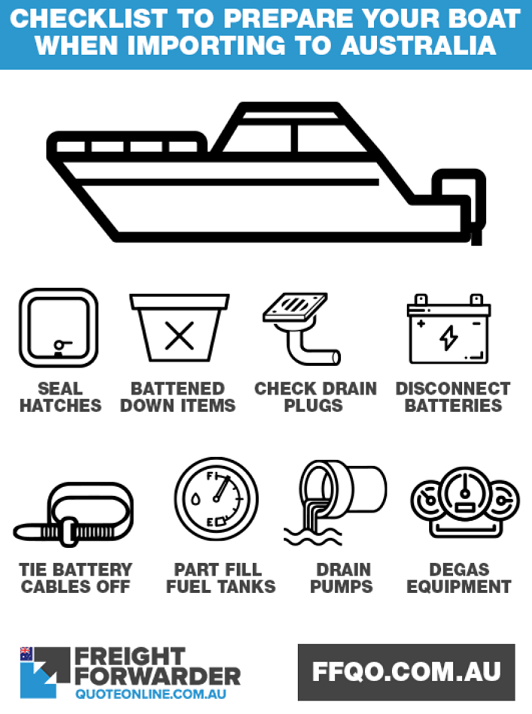
Checklist on how to prepare your boat for shipping when importing to Australia
Cover yourself with effective marine insurance
Freight forwarders do not usually include marine insurance in their quotes. It is included, it will be listed in their quote. While marine insurance is not mandatory it is certainly worthwhile. It minimises your risk exposure and thus justifies the cost when shipping a vessel to Australia. Road insurance does not indemnify the policyholder for any damage done to your vessel while en route.
Read our blog on why you need marine insurance.
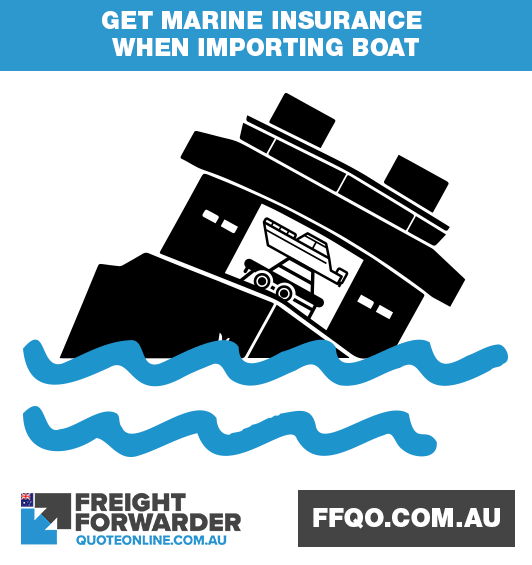
Get marine insurance when importing boat to Australia
Ensure you have all the required documentation
If asked, you must be able to provide all necessary documentation apropos your importation of a vessel to Australia. If unable to do this, your vessel will be held at the port pending the correct documentation being proffered.. It is imperative, therefore, that you take careful note.
Bill of Sale
If purchasing your boat, we will need a copy of the Bill of Sale from the seller. If you already own the boat, then we need a copy of the original purchase Bill of Sale. If this has been misplaced, then it will need to have a valuation done on arrival.
Photo identification
A top-quality colour-scan of either your passport photo page or your Australian drivers licence.
Boat title and ownership papers
In some countries or states, each vessel has a title or ownership paper. Do not request these to be amended or sent to you until the vendor is instructed by our agent. Frequently, the original documents are necessary in order to ship from the country of origin.
Certificate of Origin
If you are bringing into Australia a vessel from a country with a free trade agreement, you need a Certificate of Origin in order to avoid paying Duty. This document is filled in by the dealer or the manufacturer.

Ensure you have all the required documentation ready when importing boat to Australia
Don’t hesitate to ask for help when importing a boat into Australia
After thoroughly reviewing our checklist for importing a boat into Australia, you are welcome to reach out and ask us for help. If you realise you can’t provide one of the required documents, or you feel out of your depth and overwhelmed, feel free to contact an experienced Australian freight forwarder like us. There are several prerequisites that need to be fulfilled when importing a boat to Australia. You will not be able to import your boat without these prerequisites being met. We can help you with these.
Get marine insurance when importing boat to Australia
So if you need help, feel free to contact us online or message via our Facebook page. We are more than happy to help you when importing a boat to Australia.
Check out our other recent articles
Latest news
Read up on the latest Australian freight forwarding news and developments:
AI in freight forwarding and the changing Australian workforce - 10 Aug 2026
Marine cargo insurance – Why do you need it? - 23 Jul 2026
What is the Australian Trusted Trader program (ATTP) - 24 Jun 2026

Get social with us
Check us out on Facebook. Get social and like our page. Feel free to post your thoughts - we will appreciate it.
Come see our clips on our YouTube channel and subscribe so you are notified when we add new ones.
To keep up to date with the industry and read up on industry trends and developments, follow us on LinkedIn.
For quick updates, follow us on Twitter.
1300651233