Home » News »
Australian import common restrictions into China Japan and USA for 2026
« Previous | Next »
International trade, particularly Australia’s exports, is very important to the country’s economy. It not only allows Australians to participate in global value chains, but also enables Australian businesses to profit from access to larger international markets.
- Tariffs on Australia imports to destination countries
- Quotas on Australian imports to destination countries
- Chinese tariff rates and quotas on key Australian imports
- Japanese tariff rates and quotas on key Australian imports
- USA quotas on key Australian imports
Australian import common restrictions into China Japan and USA
Tariffs on Australia imports to destination countries
Also referred to as import duties, tariffs are taxes imposed on imported goods and are typically calculated as a percentage of the value of the imported product. They are often imposed by destination countries to protect domestic industries that are vulnerable to foreign competition. While Free Trade Agreements (FTAs) have eliminated most tariffs on Australian imports to destination countries (exports), some sensitive sectors still face these costs to help maintain a level playing field.
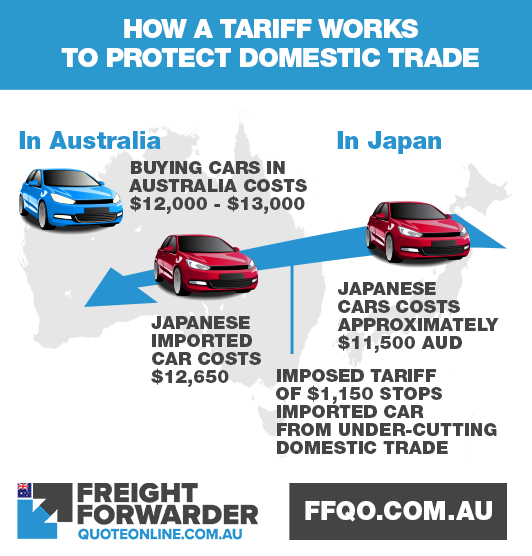
How tariffs protect domestic trade for a country
Summary of imports restriction into China, Japan and USA
Certain restrictions on Australian goods entering foreign markets, particularly in China, Japan and the United States. What are these restrictions in 2026 and how long are they expected to remain in place?
| Product | Country | Tariff rate | Common restriction and quota |
|---|---|---|---|
| Avocados | USA | 0% | Phase-out complete; now fully duty-free year-round |
| Barley | China | 0% | No volume limits; duties removed following trade stabilisation |
| Beef | China | 0% In-Quota 55% Out |
New 2026 Safeguard: Triggered once imports exceed 205,000 tonnes |
| Beef | Japan | 20.8% to 21.7% | Rates continue to drop toward 9% by 2033 via CPTPP |
| Beef | USA | 0% | Exempt: Confirmed exempt from the new 2026 US Import Surcharges |
| Cotton | China | 40% Base rate | Subject to sliding-scale global quotas Volume management is key |
| Dairy | China | 0% | All tariffs eliminated as of Jan 1, 2026 Includes milk powder |
| Dairy | USA | Variable TRQ | Duty-free for fixed volumes High tariffs for excess volumes |
| Peanuts | USA | 0% | Quotas eliminated Enters the US market freely |
| Pork | Japan | ~4.3% Out-of-quota | Significant reduction via CPTPP from the previous 8% to 10% rates |
| Sorghum | China | 0% | Non-quota grain enters duty-free regardless of export volume |
| Sugar | China | 15% In-quota 50% Out |
Excluded from ChAFTA Follows standard global tax walls |
| Sugar | Japan | Levy system | Subject to specific domestic protection levies (HS 1701.14) |
| Sugar | USA | 0% within 87,402 tonnes | Strict quota remains unchanged for Uruguay |
| Wheat | China | 65% Out-of-Quota | High tax wall for any volume outside state-allocated quotas |
| Wool | China | 0% within 44,324 tonnes | 1% tariff typically applies via WTO quota if ChAFTA limit is exceeded |
Australian imports into China, Japan and USA for 2026 table
Quotas on Australian imports to destination countries
The law of supply and demand suggests that products that are less readily available tend to become more expensive. By implementing import quotas, destination countries can limit the volume of Australian goods entering their markets, reducing supply and increasing the price of imported goods relative to domestic products once the quota has been reached.

Beware of quotas on Australian imports to destination countries
Australia’s top three trading partners
Other import restrictions, including currency controls and embargoes, may also be imposed. However, this report focuses solely on the tariff rates and import quotas applied by China, Japan and the United States. These countries are Australia’s three largest trading partners in 2026.

Australia imports to United States, China and Japan for 2024 to 2025
Chinese tariff rates and quotas on key Australian imports
The China -Australia Free Trade Agreement (ChAFTA) came into force on 20 December 2015. As of 2026, most Australian exports to China benefit from zero tariffs. However, certain agricultural products remain subject to quotas or other trade restrictions, including some limits managed under ChAFTA.
| Commodity | ChAFTA outcome | Tariff status 2026 |
|---|---|---|
| Beef | Fully eliminated | 0% within safeguard levels |
| Wine | Fully eliminated | 0% |
| Dairy | Fully eliminated | 0% as of Jan 1, 2026 |
| Sugar | Excluded | 15% – 50% WTO general rates |
Australian tariff status on key commodities with China in 2026 table
Australia imports on sugar
While ChAFTA removed tariffs on most Australian exports, sugar was excluded from the agreement. As a result, Australian sugar producers did not gain any additional market access or preferential tariff treatment. Instead of benefiting from the agreement’s free trade provisions, sugar exports remain subject to standard international trade rules.
The exclusion of sugar from ChAFTA means that Australian producers continue to face some of the most restrictive import conditions in the Chinese market.
No special treatment
Sugar remains one of the few commodities for which no concessions were granted under ChAFTA. It is classified as a sensitive product by Chinese regulators and, as a result, does not benefit from the gradual tariff reductions applied to sectors such as wool and dairy.
Standard global rates
Exclusion from the agreement means that all sugar exports are subject to the general 15% in-quota tariff or the significantly higher 50% out-of-quota tariff. These elevated out-of-quota rates create a substantial financial barrier, making it difficult for Australian sugar producers to compete on an equal footing with domestic Chinese suppliers.
Domestic protection
China maintains these high barriers specifically to protect its domestic sugar mills and farmers. This protectionist stance is unlikely to change in the 2026 trade cycle, as sugar remains a key priority for China’s regional rural employment and economic stability.
Financial impact
The 50% tariff is the primary barrier to trade. As China’s global quota is often filled quickly, any additional Australian sugar faces a significant tariff barrier. Since there is no specific side agreement under ChAFTA, Australian sugar remains at a disadvantage compared to other commodities that now enter China duty-free.
This high tariff rate makes Australian sugar less competitive. Without the preferential access granted to other sectors, exporters must pay these higher costs once initial quota limits are reached.
Australia imports on wool
Prior to the China–Australia Free Trade Agreement (ChAFTA), the tariff on Australian wool was set at a significant 38%. To address this, a duty-free annual tariff rate quota (TRQ) was introduced on 1 January 2016. This quota started at 30,000 tonnes and increased by 5% annually until it reached its peak of 44,324 tonnes on 1 January 2024. This peak allocation remains in effect for 2026, providing a stable duty-free pathway for Australian wool.
While the 38% rate still exists as the Most Favoured Nation (MFN) tariff for out-of-quota imports, Australian exporters rarely pay it. As Australia’s annual production typically exceeds the 44,324-tonne ChAFTA limit, a waterfall system is used. Once the 0% ChAFTA quota is filled, Australian wool enters China’s WTO global wool quota, which allows for approximately 287,000 tonnes at a low 1% tariff. The 38% rate only applies if both of these quotas are exhausted—an uncommon scenario that keeps Australian wool highly competitive in the Chinese market.
| Quota Tier | Quota Quantity | Tariff rate | Exceed rate |
|---|---|---|---|
| Tier 1: ChAFTA quota | 44,324 tonnes | 0% | ~75% (Move to Tier 2) |
| Tier 2: WTO global quota | ~287,000 tonnes | 1% | <1% (Move to Tier 3) |
| Tier 3: Out-of-quota | Unlimited | 38% | N/A |
ChAFTA and WTO wool tariff quota 2026 table
Australia imports on cotton
Unlike wool, Australian cotton does not currently enjoy a duty-free preference under ChAFTA and remains subject to China’s global sliding-scale quota system. While the trade relationship has stabilised and Australian cotton has returned to the Chinese market in significant volumes as of 2026, managing these quotas remains complex. Under this system, the tariff rate slides between 5% and 40% depending on the import price. If exports fall outside the allocated quota, they may face the maximum base tariff rate of 40%, making precise volume management critical for Australian exporters.
Strategic management of the China cotton sliding-scale quota in 2026
This sliding-scale system acts as a protective barrier that fluctuates in response to changing market conditions.
Price buffer
The sliding-scale system is designed so that when global cotton prices are low, tariffs are higher (up to 40%) to protect Chinese farmers from cheap imports. Conversely, when global prices are high, tariffs can fall as low as 5% to support Chinese textile mills.
Resumption of trade
With unofficial restrictions on Australian cotton lifted, Australian growers are once again actively competing for these quota allocations. In early 2026, China even issued an additional 300,000 tonnes of sliding-scale quota to meet the surge in demand for high-quality fibre.
Processing trade
Many Australian exporters utilise processing trade quotas. These allow cotton to enter at lower tariff rates if the material is intended to be manufactured into textiles within China and then re-exported to international markets.
| Import type | Tariff rate | Context for 2026 |
|---|---|---|
| In-quota (WTO) | 1% | Limited to a global pool of 894,000 tonnes |
| Sliding scale quota | 5% to 40% | Adjusted based on price; additional quotas are often released mid-year to meet demand |
| Out-of-quota (MFN) | 40% | The ceiling rate applied once all quota allocations are exhausted |
China Cotton Tariff Structure for 2026 table
Australia imports on wheat
Wheat is a highly sensitive agricultural product in China, governed by a rigid global tariff rate quota (TRQ) system. While Australian wheat is in high demand for its quality, it does not receive a dedicated duty-free allocation under ChAFTA. Instead, it must compete for a share of China’s global quota, which is capped at 9.6 million tonnes in 2026. For Australian exporters, the stakes are high. Imports within this state-allocated quota attract a low 1% duty, but any volume entering outside of it is subject to a prohibitive 65% tariff.
Navigating the 2026 wheat market requires a deep understanding of China’s centralised food security policies.
Highest barrier
This is one of the highest tariffs in international trade. It effectively prevents significant trade from occurring once the 9.6 million tonne global limit is reached, as the cost becomes commercially unviable for most millers.
State-owned enterprises
In 2026, roughly 90% of the wheat quota was reserved for Chinese state-owned enterprises (such as COFCO). Only a small 10% share is typically available to private importers, making partnerships with state buyers essential for Australian sellers seeking access to the 1% tariff rate.
Quality demand
Despite the 65% tariff threat, Australia has seen a significant surge in shipments to China in early 2026. This is driven by a need to replenish high-quality milling reserves, with bulk exports in recent months showing a sharp increase compared with previous years.
| Import type | Tariff rate | Quota limit |
|---|---|---|
| In-quota (state-allocated) | 1% | 9.636 million tonnes |
| Out-of-quota (MFN) | 65% | Unlimited |
China wheat tariff structure in 2026 table
Australia imports on maize
The trade of maize is highly controlled to ensure domestic price stability and food security within China. Similar to wheat, maize exporters must operate within strict quota limits.
For 2026, the global tariff rate quota (TRQ) for maize remains at 7.2 million tonnes. Within this quota, imports attract a minimal 1% tariff. However, any volume exported to China outside of this official allocation is subject to a base out-of-quota tariff of 20%.
Several strategic factors define the risk and opportunity for this market in 2026.
State control
Approximately 60% of the 7.2 million tonne maize quota is reserved for state-owned enterprises, leaving a limited portion for private traders.
Low price inclusion rates
Chinese feed mills increased the inclusion rate of maize in their rations in early 2026 due to relatively low domestic prices. This creates a volume opportunity for Australia, provided the 1% quota allocation can be secured before it is exhausted.
Market demand
Despite the 20% tariff barrier, China’s demand for high-quality corn for animal feed remains strong in 2026, particularly as domestic prices have fluctuated due to shifts in local crop yields..
Australia imports on canola
Australian canola seed occupies a stable but sensitive position in the 2026 trade landscape. Unlike grains that fall under quota arrangements, Australian canola is subject to a single 9% MFN tariff.
While this rate is predictable, the actual flow of trade is heavily influenced by biosecurity protocols and the broader diplomatic climate. A few specific market dynamics are shaping the canola trade as of mid-2026.
Geopolitical supply risks
Ongoing diplomatic shifts have led analysts to warn of potential retaliatory biosecurity inspections, despite trade resuming in 2025. Exporters are currently advised to maintain accurate and complete documentation to avoid administrative delays at the border.
Competitive advantage over Canada
Canada negotiated a reduction in its canola tariffs to 15% in early 2026. Australia’s 9% rate remains more competitive in the market, giving Australian growers a consistent price advantage.
GACC registration requirements
All Australian packing and storage facilities must be registered with China’s General Administration of Customs (GACC) before 2026 shipments can be authorised. This facility-level registration is separate from standard Australian export licensing and is a common cause of port-side rejection when not properly maintained.
Australia imports on barley
Barley has reclaimed its position as a cornerstone of the Australia–China agricultural relationship following the full removal of restrictive trade barriers. Under ChAFTA, Australian barley enters China duty-free with no volume quotas.
This 0% tariff rate applies to both malting barley for the brewing industry and feed barley for the livestock sector, providing Australian growers with a significant competitive advantage over other global suppliers. A few specific market dynamics are shaping the barley trade as of mid-2026.
Market share recovery
Australian barley exports to China reached approximately $1.5 billion in 2025 and have maintained strong momentum into 2026. This recovery represents a near-total restoration of Australia’s market share, as Chinese buyers have returned to Australian supply due to its consistent quality and logistical proximity.
Maize substitution effect
Feed mills in China are increasingly using barley as a direct substitute for maize to lower production costs. The 0% tariff on barley allows these mills to bypass the 20% out-of-quota tariff applied to maize, making Australian barley a key input for China’s domestic pork and poultry industries.
Record export volumes
Record winter crops in Western Australia have created a substantial exportable surplus for the 2025/26 season. This high supply has enabled Australia to meet surging Chinese demand even as global grain prices remain volatile, ensuring that Australian barley remains competitively priced against other grains.
Australia imports on dairy
The start of 2026 marks a historic milestone for the Australian dairy sector under ChAFTA. As of 1 January 2026, the remaining tariffs on all Australian dairy products, including liquid milk, cheese, butter and yoghurt, have been removed.
This includes the elimination of the final 10% tariff on milk powder, which was the last category to transition to full duty-free status. The full removal of tariffs has transformed the competitive landscape for Australian dairy processors in the Chinese market.
Completion of the 10-year phase-out
The removal of the final 10% tariff on milk powder concludes a decade-long transition toward completely duty-free trade. This milestone allows Australian producers to compete more aggressively with other major exporters that previously enjoyed earlier duty-free access.
Expansion into tier-2 cities
Lower import costs are allowing Australian dairy brands to expand beyond major coastal hubs such as Shanghai and Beijing. Distributors are increasingly targeting tier-2 cities in 2026, where demand for premium Australian infant formula and UHT milk is growing rapidly.
Reduced administrative costs
The shift to a permanent 0% tariff rate across all product lines simplifies the logistics of multi-product shipments. Exporters no longer need to manage different tariff schedules for mixed containers of cheese and milk, significantly reducing administrative overheads for smaller enterprises.
Australia imports on sorghum
Sorghum has emerged as a high-volume success story for 2026 due to its status as a non-quota grain. Unlike wheat or maize, Australian sorghum enters China at a 0% tariff rate without any restrictive annual volume limits.
This open access has allowed Australia to become a primary supplier for China’s large livestock feed and spirits industries. Exporters are leveraging the duty-free status of sorghum to bypass the more restrictive regulatory hurdles found in other grain categories.
Quota-free advantage
Sorghum’s lack of a tariff rate quota makes it a far more flexible commodity than wheat. While wheat exporters are constrained by a global limit, sorghum traders can scale volumes based entirely on market demand and Australian crop yields, which are projected to remain strong in 2026.
Baijiu production demand
A significant portion of Australian red sorghum is used in China’s traditional spirits industry. In early 2026, Chinese distilleries increased their intake of Australian sorghum due to its specific tannin content and fermentation qualities, which are often preferred over supplies from other countries.
Logistical efficiency
The proximity of Australian ports to China provides shorter transit times compared with competitors in the Americas. This logistical advantage, combined with the 0% tariff, ensures that Australian sorghum remains a cost-effective starch source for southern Chinese feed mills in the current trade cycle.
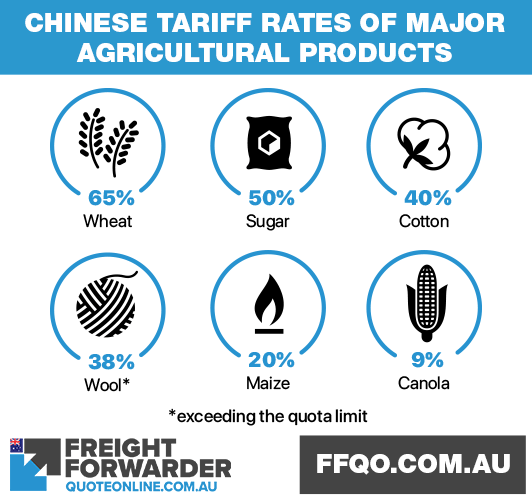
Chinese tariffs on Australia agricultural imports for 2026
Japanese tariff rates and quotas on key Australian imports
The Japan–Australia Economic Partnership Agreement (JAEPA) continues to deliver substantial benefits. By 2026, most of the phased tariff reductions have reached their final “Year 0” or lowest applicable rates.
Australia imports on rice barley and wheat
As of 2026, these staples continue to be governed by Japan’s Law for Stabilisation of Supply-Demand and Price of Staple Food. This means they are subject to government-managed tenders rather than standard commercial tariffs.
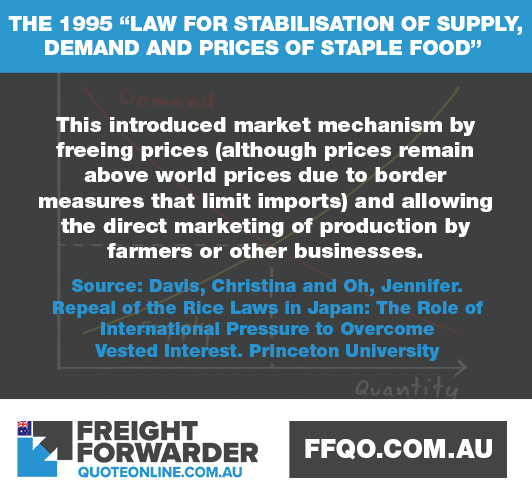
The law for stabilisation of supply-demand and price of staple food
Australia imports on sugar
Sugar remains a complex category under JAEPA. While many sugar-containing products have seen tariff eliminations, raw sugar (HS code 1701.14) is still subject to specific Japanese levy systems designed to protect domestic industry.
Australia imports on beef scheduled tariff rate under JAEPA
The Japan–Australia Economic Partnership Agreement (JAEPA) provided a major boost to the Australian beef industry by scheduling a gradual reduction in tariff rates. For frozen beef, the rate is set to fall to 19.5% by 1 April 2028, while the rate for chilled beef is scheduled to fall to 23.5% over the same period.
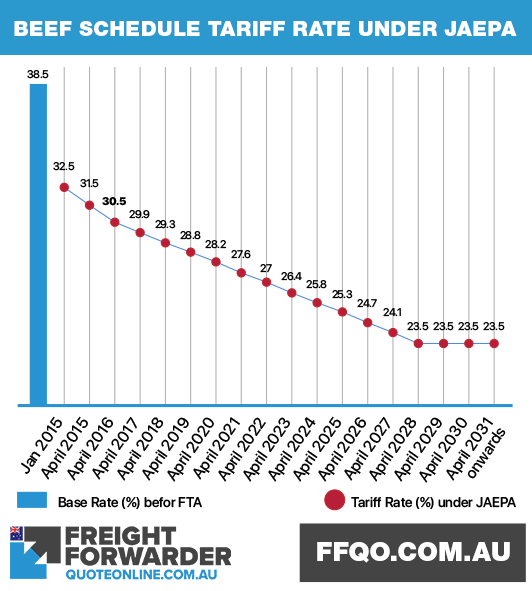
Australia imports of beef scheduled tariff under JAEPA
However, since 2018, Australian exporters have also benefited from the Comprehensive and Progressive Agreement for Trans-Pacific Partnership (CPTPP). By 2026, the CPTPP has reduced tariffs further than the original JAEPA schedule, with both chilled and frozen beef expected to approach a final target rate of 9% by 2033. These combined trade agreements are projected to increase Australian exports by up to $5.4 billion over a 20-year period.
| Beef category | JAEPA rate | CPTPP rate | Final target |
|---|---|---|---|
| Chilled beef | 21.7% | ~23% | 9% (by 2033 via CPTPP) |
| Frozen beef | 20.8% | ~23% | 9% (by 2033 via CPTPP) |
Australia imports on beef scheduled tariff rate under JAEPA 2026 table
Australian imports on pork
For exporters of pork and processed meats such as sausages, JAEPA has successfully lowered gate prices and reduced tariffs. Most processed pork products now enter Japan at significantly lower rates or duty-free, provided they meet specific meat content requirements.
While JAEPA initially targeted tariff rates of 8% to 10.7% for imports exceeding the quota, the CPTPP has since accelerated these reductions. As of 2026, Australian exporters can access an out-of-quota tariff rate of approximately 4.3% for most pork cuts, while the volume of the duty-free quota continues to provide a stable pathway for Australian trade.
| Product type | Base rate | JAEPA quota | Out of quota rate |
|---|---|---|---|
| Fresh or Chilled Pork | Variable | 14,000 Metric Tonnes | 4.3 percent via CPTPP |
| Processed Meats | High | No Quota Limit | 0 percent or near zero |
Japan out of quota tariff rate for Australian imported pork 2026 table
Impact of the 4.3% tariff rate on Australia pork above the annual quota limit
The reduction from 8.0% to 4.3% represents a significant cost saving for Australian producers once the initial quota volumes are filled. This lower rate ensures that Australian pork remains more competitive against other global suppliers, even during peak export periods when quota limits are exceeded.
USA quotas on key Australian imports
The Australia–United States Free Trade Agreement (AUSFTA) is now over 20 years old. In 2026, nearly all trade in goods between the two nations is duty-free, although some agricultural quotas still exist.
Australian import tariff and quotas on beef
As of 2023, the transition period for beef ended. Australia now enjoys unlimited duty-free access for beef into the United States. The old quotas that used to limit exports to 418,214 tonnes are no longer in effect.
Australian import tariff and quotas on dairy
Unlike beef, dairy remains subject to tariff rate quotas (TRQs) in the United States. While duty-free volumes have increased since 2005, exporters still face above-quota tariffs if they exceed specific annual allocations for products such as cheese and milk powder.
Australian import tariff and quotas on sugar
Similar to dairy products, quota access for sugar remains unchanged. It is still set at 87,402 metric tonnes under the Uruguay Round Agreements between the two countries.
Australian import tariff and quotas on tobacco and cotton
As we are now 21 years into the agreement, the 18-year elimination period for these tariffs has passed. Australian tobacco and cotton now largely enjoy duty-free and quota-free access to the US market.
Australian import tariff and quotas on peanuts
Similar to tobacco, the long-term phase-out of peanut tariffs is complete. Australian peanuts can now freely enter the United States without the 500 tonne restrictions that characterised the early years of the agreement.
Australian import tariff and quotas on avocados
The 18-year elimination period for avocado tariffs concluded in 2023. This means that Australian avocados exported to the United States are now fully duty-free year-round, regardless of season.
Contact us for help on Australian import tariffs
These various tariff rates and quotas exist within the framework of Australia’s bilateral agreements with China, Japan and the United States. Exporting goods to these countries can be complex. You may require support from an experienced brokerage team to manage your exports, so feel free to contact us.
Check out our other recent articles
Latest news
Read up on the latest Australian freight forwarding news and developments:
Implementing artificial intelligence in Australian freight forwarding - 23 Oct 2026
How to process a marine cargo insurance claim - 17 Sep 2026
AI in freight forwarding and the changing Australian workforce - 10 Aug 2026

Get social with us
Check us out on Facebook. Get social and like our page. Feel free to post your thoughts - we will appreciate it.
Come see our clips on our YouTube channel and subscribe so you are notified when we add new ones.
To keep up to date with the industry and read up on industry trends and developments, follow us on LinkedIn.
For quick updates, follow us on Twitter.
1300651233