Home » News »
AI in freight forwarding and the changing Australian workforce
« Previous | Next »
Fast-moving technological developments on AI in Australian freight forwarding are rapidly changing the nature of this work. Rather than eliminating the need for human professionals entirely, AI is making their work more efficient and creating opportunities for them to focus on higher-level tasks. AI excels at processing large volumes of data but cannot independently manage legal liability or complex compliance requirements. This critical compliance gap means traditional administrative roles are increasingly evolving into highly specialised oversight and governance positions.
- Shifting workforce roles in modern freight forwarding
- Industry principles for safe technology adoption
- Partnering with forwarders who balance technology and expertise
- Future-proof your supply chain with responsible technology
AI in Australian freight forwarding and the changing workforce
Shifting workforce roles in modern freight forwarding
Artificial intelligence excels at processing massive volumes of raw data but fundamentally lacks the capacity to manage complex legal liabilities. This technological reality means that automation from AI is shifting the nature of freight forwarding work rather than eliminating human professionals entirely. Traditional administrative roles are rapidly transforming into highly specialised governance and analytical positions to bridge this critical compliance gap.
Emerging AI roles in freight forwarding
Automation of clerical and data entry roles
Traditional data entry, compilation, and clerical roles are experiencing a rapid decline across the industry. Software now assumes much of the responsibility for the manual transcription of shipping manifests and invoices. Delegating these repetitive tasks frees human staff to focus on higher-value analytical and problem-solving activities.
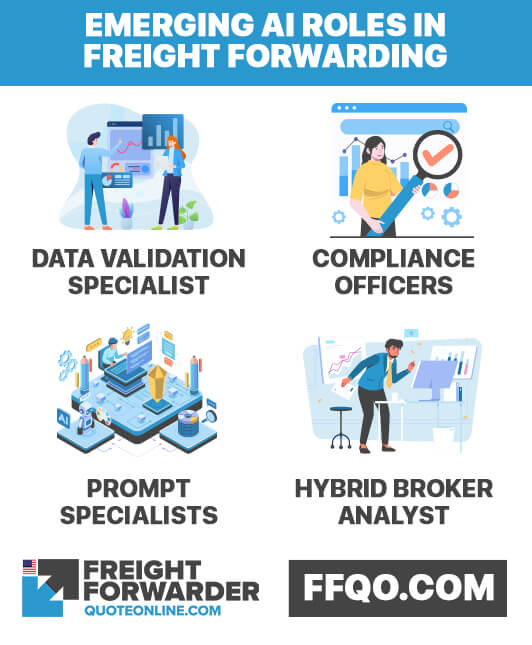
Data validation and quality assurance specialists
Technology-focused positions are rapidly emerging to safeguard supply chains against unpredictable algorithmic errors. Data validation specialists and quality assurance analysts meticulously audit machine outputs to identify and correct critical mistakes. This ensures that errors, such as a misread currency symbol, are immediately identified, preventing an automated system from drastically overvaluing a shipment and triggering severe customs penalties.
Compliance technology officers and prompt specialists
Compliance technology officers ensure that internal models remain legally up to date, particularly in response to sudden biosecurity bans or newly ratified trade agreements. Meanwhile, prompt specialists help train and configure AI systems to accurately interpret complex maritime terminology and strict liability requirements. By deploying these experts, businesses can help ensure that artificial intelligence systems operate within current legal and regulatory frameworks.
Modern hybrid broker analyst
Freight forwarders are increasingly evolving into hybrid data analysts. Licensed brokers can use powerful analytical insights to proactively restructure supply chains rather than simply processing basic paperwork. Applying this advanced data analysis enables professionals to help clients achieve significant savings on duties and overall freight forwarding costs while maintaining regulatory compliance.
Industry principles for safe AI technology adoption in forwarding
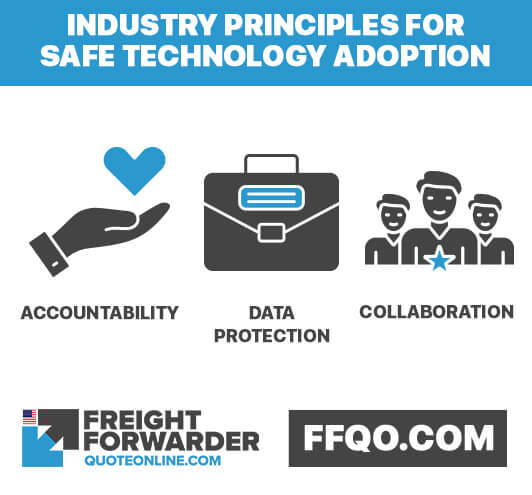
Navigating these workforce changes safely requires Australian freight forwarders to adhere strictly to established regulatory guidelines. The International Forwarders and Customs Brokers Association of Australia outlines specific policy principles to govern the responsible integration of technology. Following these comprehensive frameworks helps ensure that businesses maintain supply chain trust and achieve the highest standards of regulatory compliance.
Industry principles for safe technology adoption
Strict human accountability and oversight
A fundamental policy to govern the use of AI technology is to ensure strict human accountability. Freight forwarders must rigorously apply these core guidelines to protect supply chains from potentially devastating compliance failures:
- Artificial intelligence must be used exclusively as an assistive tool to support, rather than replace professional human judgement
- Final regulatory decisions regarding tariff classification or valuation must remain solely with appropriately qualified professionals
- AI systems must not independently execute critical regulatory actions, such as lodging customs declarations, without explicit human authorisation.
- Businesses must establish clear internal policies defining acceptable technology use and maintain complete transparency with clients
Data protection and commercial confidentiality
Cybersecurity and the protection of highly sensitive commercial data remain absolutely paramount in modern freight forwarding. Feeding confidential client information into unverified public platforms exposes businesses to significant risks, including data breaches and targeted exploitation.
Criminal actors are actively weaponising artificial intelligence to generate falsified documentation and orchestrate sophisticated sanctions evasion. Defending global supply chains against these malicious threats requires sensitive regulatory documents to be stored and processed within strictly controlled, enterprise-grade digital environments. Therefore, it is essential for forwarders to maintain robust data security protocols to prevent severe reputational damage and potentially catastrophic legal penalties.
Collaborating with regulatory bodies
Protecting global trade networks necessitates close collaboration with key government regulators, including the Australian Border Force and the Department of Agriculture, Fisheries and Forestry. Proactive engagement with these regulators will help ensure that the adoption of new technologies, such as AI, actively benefits freight forwarders and enhances trade facilitation while preserving the absolute integrity of Australia’s borders.
Industry leaders strongly support continuous information sharing on emerging cybersecurity threats to ensure that all supply chain participants can be alerted promptly. Establishing clear regulatory boundaries will help ensure that automated systems operate safely without compromising national security or strict customs compliance.
Partnering with freight forwarders who balance AI and expertise
Australian importers and exporters ultimately require freight forwarders who clearly understand where automated processing ends and professional human expertise begins. Finding the right balance ensures supply chains remain highly efficient while strictly adhering to international trade laws.
Ensure there is no over-reliance on automation
Traders must carefully evaluate their freight forwarder providers to avoid the severe operational consequences of over-automation. Entrusting complex shipments to platforms lacking experienced oversight can frequently result in unresolved clearance bottlenecks and misclassified goods. These preventable logistical failures can directly translate into expensive terminal storage fees and delayed market entry.
Check for a balance between data processing speed and human accountability
The most reliable supply chain strategies seamlessly combine rapid data processing with highly skilled professional judgement. Capable forwarders can leverage AI systems to instantly draft declarations while dedicating experienced staff to complex tasks, such as negotiating carrier rates during capacity shortages. This balanced approach maximises logistical efficiency while maintaining the interpersonal trust required to secure the most appropriate shipping terms for each shipment.
Ask how high-stakes supply chain exceptions are managed
Unpredictable global events, such as sudden port strikes, geopolitical conflicts or unexpected ship rerouting. This requires immediate and creative problem-solving that algorithms fundamentally lack. Navigating these complex supply chain crises demands dedicated industry experts who can quickly secure emergency storage space or negotiate alternative transport routes when disruptions arise.
Verify that there is dedicated human oversight
It is important to engage freight forwarders who view artificial intelligence as a powerful tool rather than a complete replacement for human professionals. Achieving this technological balance helps ensure supply chains remain agile, legally compliant and fully protected against the unpredictable nature of global trade. Importers who prioritise dedicated human oversight can gain a significant advantage over competitors relying solely on automated digital platforms.
Future-proof your supply chain with responsible use of AI technology
Artificial intelligence is rapidly evolving from a simple software tool into foundational infrastructure for global trade. The ultimate challenge facing Australia’s freight forwarding sector is not whether to adopt these powerful systems, but how to deploy them responsibly. Embracing this inevitable technological shift requires a steadfast commitment to preserving professional standards and maintaining trust across the international supply chain.
Smart Australian importers and exporters are actively seeking freight forwarding partners who use AI systems to enhance their workforce rather than replace it. These industry leaders choose dedicated professionals who prioritise rigorous governance and compliance integrity over raw processing speed. Securing an experienced freight forwarder that works to this alignment remains one of the most effective ways to future-proof your supply chain against the evolving complexities of modern international shipping regulations.
Discuss your freight forwarding needs with our team today
Getting the best from your supply chain has never been more important. Get a quote through our instant sea freight quote tool to see how we can assist you. You can also send us an online message or follow our latest updates on our LinkedIn or Facebook pages.
Call our team directly on 1300 651 233 to discuss secure and compliant freight solutions for your business today.
Check out our other recent articles
Latest news
Read up on the latest Australian freight forwarding news and developments:
Implementing artificial intelligence in Australian freight forwarding - 23 Oct 2026
How to process a marine cargo insurance claim - 17 Sep 2026
AI in freight forwarding and the changing Australian workforce - 10 Aug 2026

Get social with us
Check us out on Facebook. Get social and like our page. Feel free to post your thoughts - we will appreciate it.
Come see our clips on our YouTube channel and subscribe so you are notified when we add new ones.
To keep up to date with the industry and read up on industry trends and developments, follow us on LinkedIn.
For quick updates, follow us on Twitter.
1300651233