Home » News »
Implementing artificial intelligence in Australian freight forwarding
| Next »
Artificial intelligence is rapidly rising across global supply chains and logistics. Importers and exporters face a shifting landscape where technology promises faster processing but also introduces new compliance risks.
At Freight Forwarder Quote Online Australia, we maintain a clear position on this technology. We believe that artificial intelligence must remain an assistive tool rather than a replacement for professional human judgement. We want to reassure Australian business owners that while technology is evolving, regulatory accountability and compliance remain firmly in the hands of our experienced licensed professionals.
- What tasks can be safely delegated to artificial intelligence?
- Why do human brokers remain irreplaceable?
- Critical difference between brokers and reactive AI systems
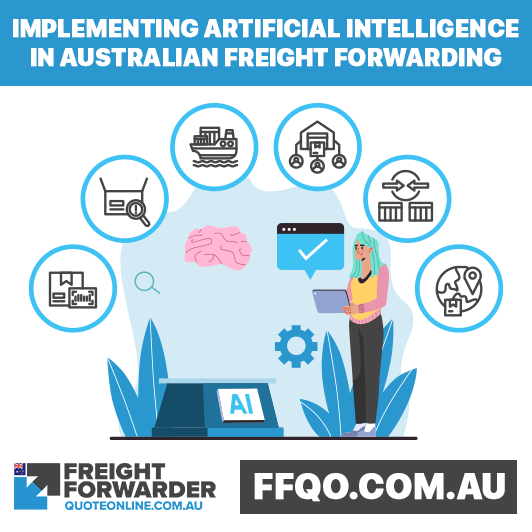
Implementing artificial intelligence in Australian freight forwarding
What tasks can be safely delegated to artificial intelligence?
Businesses must first understand which high-volume and repetitive administrative tasks this technology excels at processing without compromising strict regulatory compliance. Delegating these specific execution steps safely eliminates manual data entry and allows human teams to focus entirely on complex exception handling.
Document checking and consistency validation
Software instantly cross-references multi-page shipping documents like commercial invoices, packing lists, and bills of lading. Artificial intelligence reads unstructured data across all files simultaneously to flag critical inconsistencies, such as a weight discrepancy or a mismatched buyer address. This automated system highlights conflicts long before the data reaches a customs authority. The technology never alters data independently and relies entirely on human operators to resolve the flagged issues.
Preparation of draft declarations
Intelligent document processing automatically extracts line-item details from vendor invoices and populates them directly into customs management systems. This technology accurately reads product descriptions, quantities, and currencies to slash the time required to draft an entry from 45 minutes down to under 5 minutes. The entry remains strictly in a pending state. A licensed customs broker must ultimately review the line items and apply necessary legal logic before officially submitting the declaration.
Predictive biosecurity and customs risk identification
AI systems instantly screen cargo manifests against complex and rapidly shifting government watchlists. The system identifies high-risk combinations of origin countries, suppliers, or products requiring special biosecurity permits. The software serves purely as an early-warning filter that pulls complex files out of the automated queue. Compliance experts then inspect these specific shipments much closer to ensure safety.
Data analytics for supply chain optimisation
Artificial intelligence aggregates thousands of historical data points, including carrier transit times, port congestion spikes, and seasonal rate shifts. This proactive intelligence allows forwarders to accurately predict delays and forecast more reliable multi-modal routes. Delegating this purely analytical function carries zero risk of legal non-compliance. Logistics professionals simply use the generated data to make better-informed commercial choices
Customer service through virtual support
Natural language interfaces handle routine client inquiries regarding container locations and estimated arrival times. The technology answers these basic questions instantly around the clock by pulling real-time milestone data from transport management systems. The automated system cleanly transfers the chat to a live account manager the moment a complex problem arises, such as cargo damaged in transit.
Workflow automation to reduce manual tasks
Automation eliminates the operational friction caused by constantly moving data between emails and shared folders. Software scans shared operations inboxes to identify quote requests or pre-alerts automatically. The program extracts attached documents and creates a new shipment record to instantly alert the assigned operator. This process handles the administrative pipeline without touching any legal or strategic shipment components.
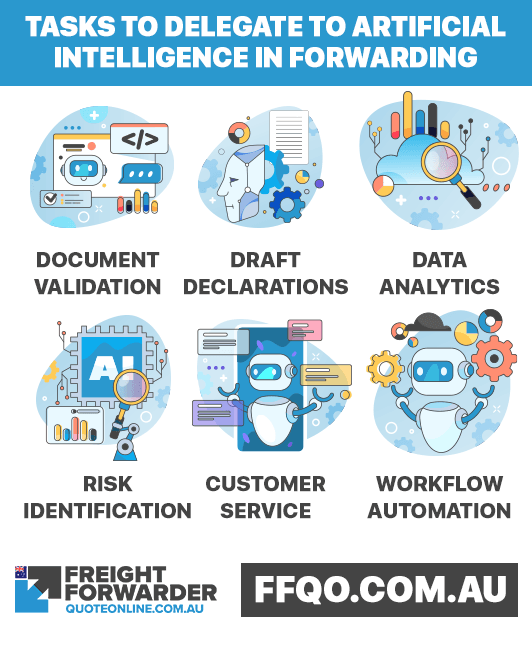
Freight forwarding tasks which can be safely delegated to artificial intelligence
Why human brokers remain irreplaceable?
Industry experts highlight several specific operational realities that prove exactly why human customs professionals remain completely irreplaceable.
| Capability | AI’s Role (Streamline) | Human’s Role (Irreplaceable) |
|---|---|---|
| Documentation | Instantly extracts, matches, and logs line items from multi-page commercial invoices | Audits the high-risk entries and signs off under legal liability |
| Routing | Calculates multi-modal routes using real-time predictive congestion data | Executes crisis rerouting when global infrastructure breaks down unexpectedly |
| Client Relations | Handles routine customer service updates via automated tracking portals | Manages trust, resolves disputes, and builds long-term commercial partnerships |
AI streamlines the work and humans remain accountable
Inability to ask targeted questions
Artificial intelligence is inherently reactive and relies entirely on provided prompts or datasets. It cannot sense when critical information is missing from a vague invoice. Human brokers, conversely, act proactively by pausing transactions and triggering investigative loops to ensure absolute accuracy.
Lack of engineering intuition
AI systems lack the physical and engineering intuition required to navigate complex international trade laws. Software struggles with Harmonized System rules of precedence, such as determining the “essential character” of a composite good (e.g., classifying a wine bottle, glasses, and corkscrew as one gift set rather than distinct items) or distinguishing between standard and military-grade steel.
Inefficacy to investigate multi-tier transactions
Determining if a product qualifies for duty-free status under a Free Trade Agreement requires calculating Regional Value Content or verifying a Change in Tariff Classification. AI cannot independently investigate multi-tier global supply chains to verify if goods underwent a “substantial transformation,” which requires human auditing.
Blindness to off-invoice valuation adjustments
AI systems only process what is explicitly written on digital documents. They cannot detect hidden financial realities, such as related-party transactions that artificially lower prices, or off-invoice additions like royalties and free manufacturing blueprints (assists) that must be legally added to the customs value.
Mismanagement of physical nuances
Government biosecurity agencies rapidly change their risk profiles based on real-world, live outbreaks. AI pattern-matching systems frequently miss crucial physical nuances, whereas human brokers know exactly how to cross-examine suppliers about specific treatments (like steam-cleaning machinery or treating timber) to prevent biological contamination and seized cargo.
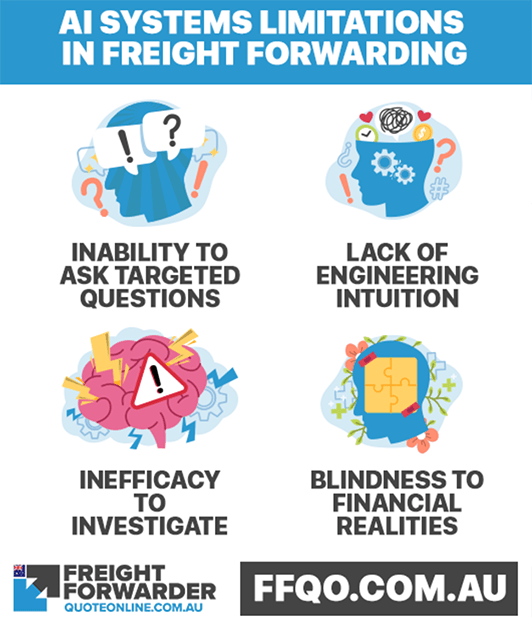
Limitations of AI systems in freight forwarding
Critical difference between brokers and reactive AI systems
Artificial intelligence fundamentally lacks the capacity to formulate targeted and situational questions because the technology is inherently reactive. These AI systems require specific prompts or structured datasets to generate an output. On the contrary, licensed customs brokers operate proactively. Industry professionals do not simply guess a probability upon encountering a vague invoice line item. Human experts pause the transaction and trigger an investigative loop to ensure absolute accuracy.
Software cannot sense when critical information is dangerously missing. The technology simply looks at vague descriptions, calculates the highest mathematical probability based on training data, and hallucinates potentially incorrect classification codes. This technological blindness creates severe compliance risks, including seized cargo, corporate audits, and massive financial penalties. This inability to investigate missing details becomes even more dangerous when applying strict trade laws to complex shipments.
Differences between custom brokers and AI systems
Shield your business from automated compliance risks
Artificial intelligence introduces severe regulatory risks to the global logistics industry. Unchecked automation frequently leads to seized cargo and massive financial penalties. Businesses gamble directly with their legal accountability when trusting fully automated digital platforms.
Smart industry leaders are actively walking away from these dangerous operational models. These companies choose logistics partners who seamlessly combine rapid processing speeds with strict human oversight. Experienced licensed customs brokers remain the only reliable safeguard. These professionals actively validate data to shield commercial margins from an industry rushing blindly towards automation.
Protecting your supply chain has never been more important. Try our online instant sea freight quote tool and get free and unlimited quotes. Learn more about us on social media and follow us on our LinkedIn or Facebook page. You are welcome to call us directly on 1300 651 233 to discuss secure and compliant freight solutions for your business today.
Check out our other recent articles
| Next »
Latest news
Read up on the latest Australian freight forwarding news and developments:
Implementing artificial intelligence in Australian freight forwarding - 23 Oct 2026
How to process a marine cargo insurance claim - 17 Sep 2026
AI in freight forwarding and the changing Australian workforce - 10 Aug 2026

Get social with us
Check us out on Facebook. Get social and like our page. Feel free to post your thoughts - we will appreciate it.
Come see our clips on our YouTube channel and subscribe so you are notified when we add new ones.
To keep up to date with the industry and read up on industry trends and developments, follow us on LinkedIn.
For quick updates, follow us on Twitter.
1300651233