Home » News »
How to process a marine cargo insurance claim
« Previous | Next »
Unforeseen events can damage your cargo during international transit despite the best packing efforts. Knowing the exact steps to process a marine insurance claim ensures you recover your financial losses quickly. This guide outlines the necessary paperwork and specific procedures you must follow to secure your compensation.
- Immediate actions to take after cargo damage
- Essential documents required for your claim
- Role of your freight forwarder in insurance claims
- Step by step marine cargo insurance claim procedure
- Things to avoid when purchasing marine insurance
- Frequently asked questions (FAQs)
How to process a marine cargo insurance claim
Immediate actions to take after cargo damage
Discovering damaged goods requires immediate and careful action. Failing to mitigate further loss can result in your insurance provider denying your claim entirely.
- Assess the cargo damage thoroughly and compile a detailed list of all affected items
- Preserve the damaged shipping goods and retain the original packaging as physical evidence
- Capture clear photographs of cargo and secure official delivery receipts upon shipment arrival
- Implement immediate mitigation steps and protect remaining cargo from experiencing any further loss
Essential documents required for your claim
Filing a successful claim depends heavily on submitting authentic and accurate documentation.
Primary claim documents
Claimants must submit standard administrative proof of their policy to establish the legal basis of a maritime insurance payout.
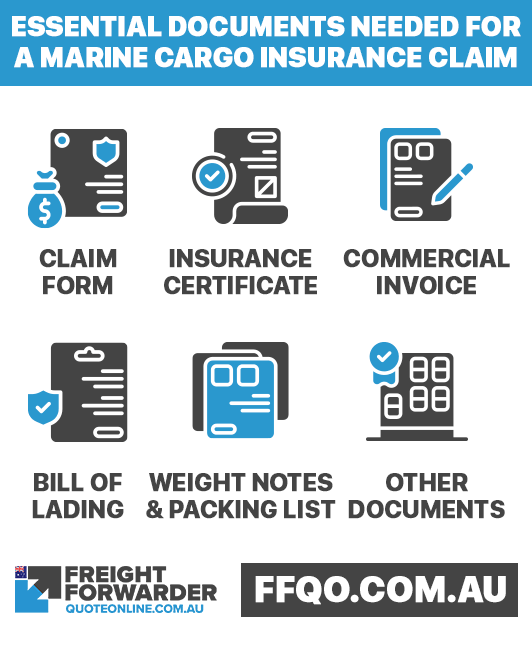
- An official claim form containing accurate policy details and precise incident descriptions
- The original insurance certificate verifying specific cargo coverage and policy exclusions
Shipping and commercial documents
Marine underwriters require official transport records to verify the physical ownership and the financial value of the cargo.
- A commercial invoice showing the exact transaction value of the transport cargo
- The bill of lading establishing ownership and physical condition at loading time
- Detailed packing lists and weight notes outlining the precise inventory of goods
Supporting evidence and reports
Additional documentation verifies the exact financial loss and helps investigators rule out cargo theft.
- Copies of all official correspondence sent to carriers and the insurance company
- A detailed claim bill outlining the estimated loss with clear math calculations
- An official police report verifying the event if the claim involves cargo theft
Essential documents needed for a marine cargo insurance claim
Role of your freight forwarder in insurance claims
Freight forwarders can serve as valuable intermediaries who arrange marine cargo insurance on your behalf. Understanding their exact responsibilities prevents confusion during the claims process.
Arranging your insurance coverage
Purchasing coverage through a freight forwarder helps match policies to complex shipments. The forwarder coordinates with the insurer to issue the required certificate detailing your coverage.
Filing the actual claim
Filing the claim remains the ultimate responsibility of the insured party, such as the exporter or importer. The insured must directly notify the insurer or broker as soon as loss or damage is discovered to meet strict notice periods.
Understanding forwarder liability
A freight forwarder is not the insurance underwriter. These providers do not evaluate or settle financial losses. Freight forwarders carry their own distinct liability which operates differently from comprehensive cargo coverage. Forwarders only assume responsibility for filing claims when named as the insured policyholder for that specific shipment.
Step by step claim marine cargo insurance claim procedure
Navigating the formal process requires strict adherence to insurer timelines.
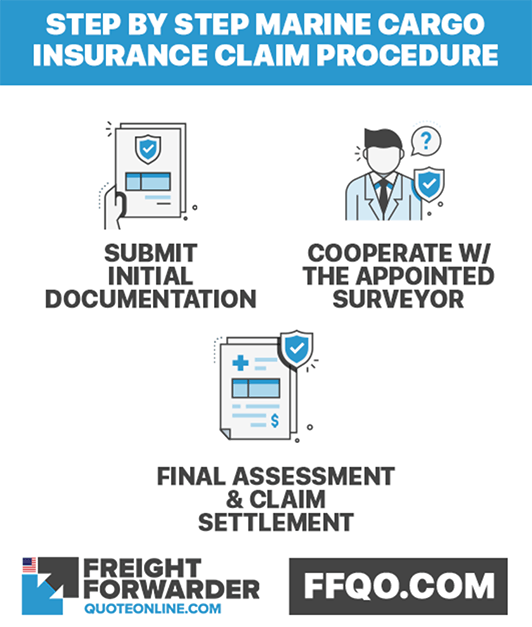
Submitting your initial documentation
Submit your initial documentation including the claim form, bill of lading, and commercial invoices to support your financial recovery.
Cooperating with the appointed surveyor
The insurance provider will appoint a licensed surveyor to inspect the affected goods and evaluate the severity and cause of the damage. Cooperate transparently with the surveyor and provide any additional requested evidence to support their final report.
Final assessment and claim settlement
The surveyor will compile a detailed final report of all their findings. The insurer will decide to approve and settle your claim fully or partially based on this report and your submitted documents.
Step by step marine cargo insurance claim procedure
Things to avoid when purchasing marine insurance
Avoiding these common mistakes during the purchasing phase will prevent problems when filing a future claim.
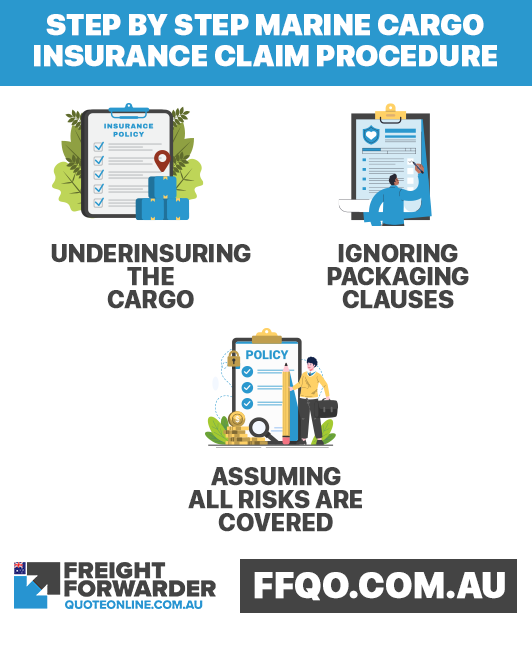
Underinsuring the cargo
Declaring a lower cargo value to reduce premium costs directly leads to reduced insurance payouts during a loss event. Underwriters calculate payouts proportionally when the declared sum falls below the actual replacement value of the goods.
Ignoring packaging clauses
Substandard packaging methods frequently void cargo insurance claims entirely. Insurers require strict adherence to standard packing guidelines before approving any financial payouts.
Assuming all risks are covered
Reviewing policy terms remains absolutely necessary because basic contracts exclude critical events like war risks or shipping delays. Importers must secure specific coverage add-ons to protect shipments from these common international trade disruptions.
Things to avoid when purchasing marine insurance
Frequently asked questions on marine cargo insurance claims (FAQ)
Can my freight forwarder arrange marine cargo insurance on my behalf?
Many freight forwarders offer an excellent intermediary service to help secure the exact policy required. Utilising their industry expertise ensures the final insurance certificate perfectly matches the specific commercial invoice and complex routing requirements.
Why must I file the claim if my freight forwarder purchased the policy?
Insurance contracts legally exist strictly between the underwriter and the designated policyholder. Navigating the claims process requires direct interaction from the actual owner of the goods because third-party intermediaries lack the legal authority to accept settlement payouts on your behalf.
Will my freight forwarder compensate me if they are not directly at fault for the damage?
Obtaining compensation from a freight forwarder requires clear proof that their negligent actions directly caused the cargo damage. Unavoidable maritime disasters like severe storms or pirate attacks force businesses to absorb the entire financial loss unless they hold dedicated marine insurance.
Why is insurance vital when shipping under specific Incoterms like CIF or FOB?
Commercial trade terms legally define the exact moment the buyer assumes all transit risks from the seller. Shipping under CIF (Cost, Insurance, and Freight) agreements legally requires the seller to procure marine insurance on behalf of the buyer. Utilising FOB (Free On Board) terms transfers all financial risk directly to the buyer the moment the cargo is physically loaded onto the departing vessel. Securing comprehensive coverage ensures your financial interests remain completely insulated during the specific legs of the journey where you hold total legal responsibility.
Can a freight forwarder void my insurance claim if they improperly pack the container?
Underwriters aggressively investigate the root cause of every incident and will quickly deny claims linked to negligent stowage. Maintaining your coverage validity requires strict adherence to international packing standards by whoever physically loads the shipping container.
Why is standard insurance necessary if my goods are low risk and not fragile?
Durable commodities still face catastrophic threats such as a total ship sinking or containers washing overboard during severe weather. Replacing an entire shipment of bulk goods requires massive capital that standard freight forwarder agreements will never reimburse.
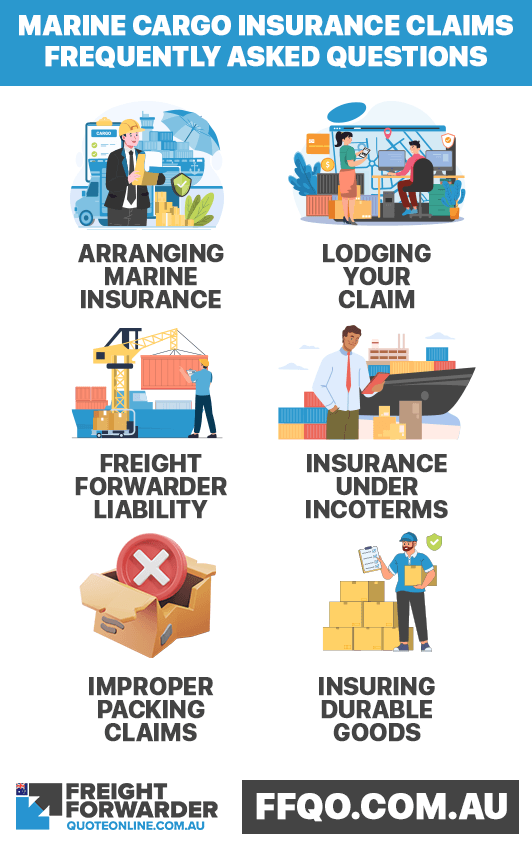
Frequently asked questions on marine cargo insurance claims (FAQ)
Discuss secure freight solutions today
Securing cargo against international shipping risks requires dedicated industry expertise. Use our online instant sea freight quote tool to receive free and unlimited quotes. Follow our LinkedIn or Facebook pages to discover how our experienced freight forwarders safeguard shipments. Call our team directly on 1300 651 233 to discuss secure and compliant freight solutions for your business today.
Check out our other recent articles
Latest news
Read up on the latest Australian freight forwarding news and developments:
Implementing artificial intelligence in Australian freight forwarding - 23 Oct 2026
How to process a marine cargo insurance claim - 17 Sep 2026
AI in freight forwarding and the changing Australian workforce - 10 Aug 2026

Get social with us
Check us out on Facebook. Get social and like our page. Feel free to post your thoughts - we will appreciate it.
Come see our clips on our YouTube channel and subscribe so you are notified when we add new ones.
To keep up to date with the industry and read up on industry trends and developments, follow us on LinkedIn.
For quick updates, follow us on Twitter.
1300651233